What are indirect questions?
Indirect questions are a polite way to ask for information. Instead of asking a direct question, you embed the question inside a larger, more formal introductory phrase, and the word order changes from question order to statement order.
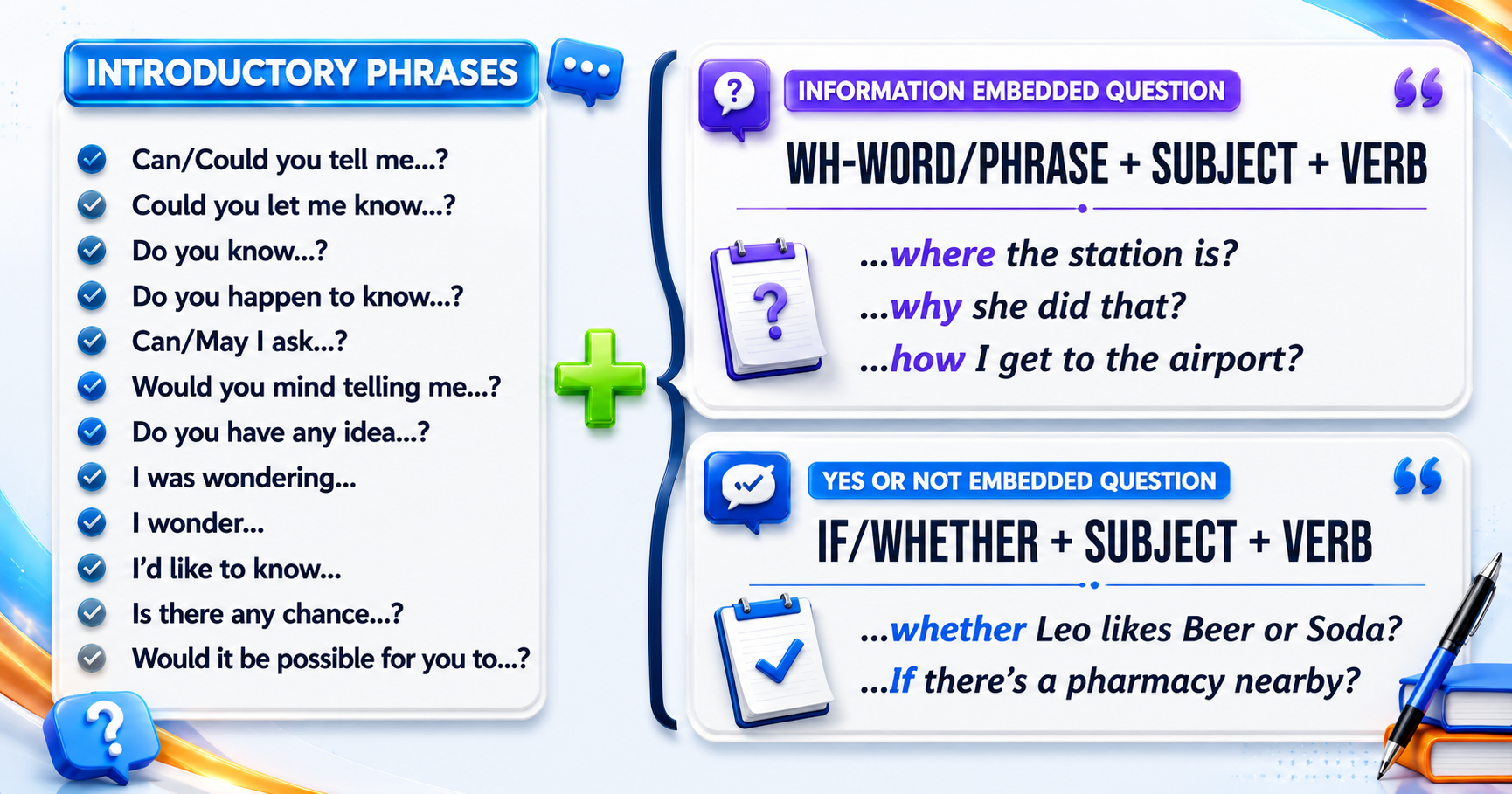
Structure & form — how to build them
The golden rule: shift from question word order to statement word order. In a direct question, the auxiliary comes before the subject. In an indirect question, the subject comes before the verb, exactly like a normal positive sentence — you saw this above with the Wh- word and if/whether structures. That same shift applies across every tense and modal:
| Tense / type | Direct question | Indirect question |
|---|---|---|
| Present Simple | Where do you live? | I'd like to know where you live. |
| Past Simple | Why did you leave early? | I was wondering why you left early. |
| Present Continuous | What are they doing? | Could you let me know what they are doing? |
| Present Perfect | Have you finished the report? | Do you have any idea if you have finished the report? |
| Modals (can/should) | Where should we park? | Would you mind telling me where we should park? |
| Future (will) | When will the package arrive? | Is there any chance you know when the package will arrive? |
The trap of "do", "does" and "did"
Crucial rule: do, does and did vanish as auxiliary verbs when you build an indirect question. They only exist to carry tense and form questions in direct structures — once the sentence becomes a statement, the main verb absorbs that tense.
| Direct | Indirect |
|---|---|
| What did you eat for breakfast? | Could you tell me what you ate for breakfast? (past tense absorbed by the main verb) |
| Where does he hide his snacks? | I wonder where he hides his snacks. |
Are If and Whether Interchangeable?
You cannot say they are always interchangeable.
While if and whether are often interchangeable in simple indirect yes/no questions (e.g., "She asked if/whether I was ready"), there are specific grammatical contexts where only whether is correct. Using if in these situations is considered grammatically incorrect in standard English.
Mandatory uses of "whether"
You must use whether instead of if in the following four scenarios:
1. Before an infinitive (to + verb)
When the indirect question is followed immediately by an infinitive, only whether is permitted.
❌ Incorrect: "I don't know if to stay."
2. After a preposition
If the clause follows a preposition (e.g., about, on, in, of), you must use whether.
❌ Incorrect: "We argued about if it was fair."
3. At the beginning of a sentence (subject clause)
When the indirect question acts as the subject of the sentence, whether is required. "If" cannot start a subject clause.
❌ Incorrect: "If we win is unclear."
4. Immediately before "or not"
While both can be used when "or not" appears at the end of the clause, only whether can be immediately followed by "or not."
❌ Incorrect: "I don't know if or not he is coming."
✅ Acceptable: "I don't know if he is coming or not."
Summary of interchangeability
In standard reported speech where none of the above constraints apply, they are generally interchangeable, though whether is preferred in formal writing to avoid ambiguity with conditional statements.
Not interchangeable: "It depends on whether (not if) he agrees."
Native speaker preferences vs. prescriptive grammar
Textbooks teach rigid rules, but everyday spoken English bends them based on context and psychology.
Dropping the introductory phrase
Native speakers often skip the full structure and rely on rising intonation or conversational setup instead.
Natural spoken: "Hey, you wouldn't happen to know where the restroom is, would you?"
Double indirects (softeners)
To sound extra polite or cautious, native speakers frequently stack two introductory phrases together.
The "I wonder" statement
Technically a statement (no question mark), but used with a questioning tone to get a response without pressuring the listener.
Common mistakes to avoid
| Learner mistake ❌ | Correct form ✅ | Explanation |
|---|---|---|
| Do you know where is the bank? | Do you know where the bank is? | Forgetting to change the word order back to subject-verb. |
| Can you tell me what did she say? | Can you tell me what she said? | Keeping the auxiliary verb "did" in the embedded clause. |
| I wonder that we have a meeting. | I wonder if / whether we have a meeting. | Using "that" instead of if/whether for yes/no concepts. |
| Let me know if to go to the party. | Let me know whether to go to the party. | Using "if" instead of "whether" before an infinitive verb. |
Fun & practical examples
Indirect questions are fantastic for awkward, bizarre, or humorous social scenarios. Practice these to master the tone.
Direct: "Does my cat plot to murder me?"
Indirect: "I would love to know if my cat is actively plotting my demise."
Direct: "Why did my boss send a single question mark?"
Indirect: "Could you possibly let me know why management sent a lone punctuation mark that has induced mild cardiac arrest?"
Direct: "Will you help me bury this treasure chest?"
Indirect: "I was wondering if there is any chance you'd be down to help me hide some suspicious heavy bags in the backyard under the moonlight?"
Exercises
Exercise 1 — Complete the indirect question
Write the second part of each indirect question. Example: Where are the biscuits? → Can you tell me where the biscuits are?
Exercise 2 — Choose the correct answer
1. When can we use indirect questions?
2. Which of the following is an indirect question?
Exercise 3 — True, false, or which definition?
1. True or false: an indirect question can be a question within a question.
2. What is an indirect question?
3. True or false: an indirect question can be a question within a statement.
Exercise 4 — Spot the indirect question
Choose the option that IS an indirect question.
1.
2.
3.
4.
5.
Exercise 5 — Spot the mistake
1. "Could you tell me where is the nearest subway station?"
2. "I wonder why did the train arrive forty minutes late."
3. "Do you know if to submit the report by Friday or Monday?"
4. "I'd like to know what time does the museum close on Sundays."
5. "Can you let me know whether or not you can attend the workshop."
6. "She asked me do I wanted a cup of coffee."
7. "We are discussing if to upgrade our software licenses this year."
8. "Do you have any idea where they have hidden the backup keys?"
9. "I was wondering if could you help me move this heavy couch."
10. "Can you tell me what did you do during your internship?"
Exercise 6 — Why are the following incorrect?
1. "I wonder what is the time."
2. "Could you tell me what means this word?"
3. "I want to know what is love."