Form
Positive
| Subject | Structure | Example |
|---|---|---|
| I / He / She / It | was + verb-ing | I was sleeping at midnight. |
| You / We / They | were + verb-ing | They were talking in the corridor. |
Negative
| Subject | Structure | Example |
|---|---|---|
| I / He / She / It | wasn't + verb-ing | She wasn't listening. |
| You / We / They | weren't + verb-ing | We weren't watching TV. |
Questions
| Type | Structure | Example |
|---|---|---|
| Yes/No | Was/Were + subject + verb-ing? | Were you working at 9 p.m.? |
| Wh- | Wh- + was/were + subject + verb-ing? | What were you doing? |
Use
| Use | Examples |
|---|---|
| Action in progress at a specific past timeCan include a second, shorter action mentioned at the same moment — but that second action does NOT interrupt or stop the action in progress. It just marks when it was happening. |
At 10 p.m. last night, I was reading in bed.
This time yesterday she was flying to New York.
I was cooking dinner when she walked in. (she walking in doesn't stop the cooking)
|
| Action in progress in the past interrupted by a short actionUsed with "until" + Past Simple. Unlike the use above, here the second action DOES interrupt and stop the action in progress. |
I was playing a game until the electricity went out.
She was studying until her friends arrived.
|
| Background scene in a story |
The sun was shining and birds were singing when he left the house.
|
| Two actions happening simultaneously |
She was cooking while he was setting the table.
|
When, Until and While
These three words often go with the Past Continuous, but they don't mean the same thing:
Long action (Past Continuous)
Short action (Past Simple)
I was walking home
when it started to rain.
While she was studying,
her phone rang.
When vs. Until vs. While:
These three words all go with the Past Continuous, but they signal different things.
When marks the moment the action in progress was happening — it does NOT interrupt it: "I was watching TV when Jim knocked the door" (the knock doesn't stop the watching, it just marks the moment).
Until means the second action DOES interrupt and stop the action in progress: "I was playing a game until the electricity went out" (the game stopped).
While means two actions were developing simultaneously, side by side: "She was cooking while he was setting the table."
When marks the moment the action in progress was happening — it does NOT interrupt it: "I was watching TV when Jim knocked the door" (the knock doesn't stop the watching, it just marks the moment).
Until means the second action DOES interrupt and stop the action in progress: "I was playing a game until the electricity went out" (the game stopped).
While means two actions were developing simultaneously, side by side: "She was cooking while he was setting the table."
Common mistake:
"I was at home this weekend" ❌ — This describes where you were, not what you were doing. Use Past Simple: "I stayed at home this weekend." ✓
Word Order: When vs. While
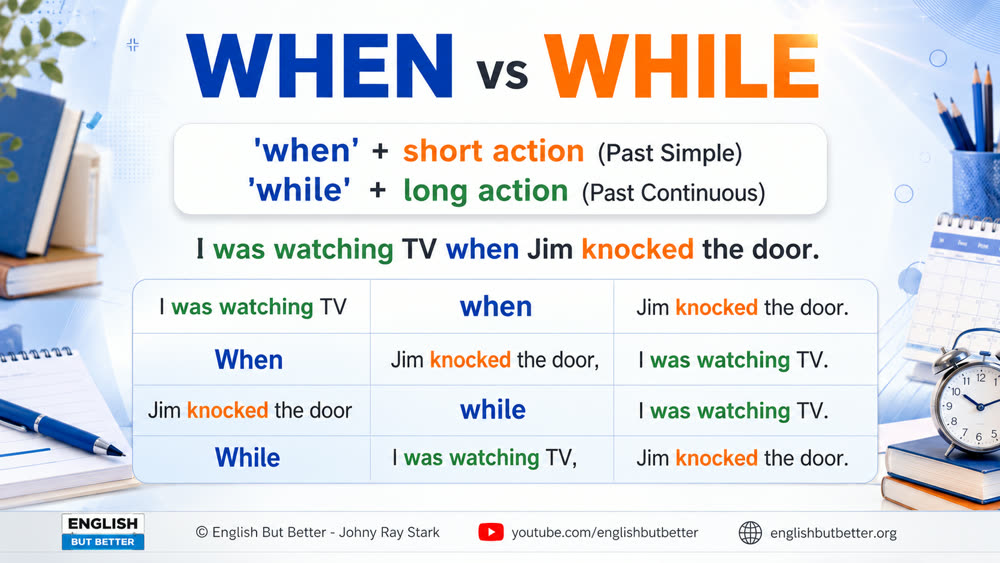
'when' + short action (Past Simple tense)
'while' + long action (Past Continuous tense)
I was watching TV when Jim knocked the door.
| Pattern | Example |
|---|---|
| [long action] + when + [short action] | I was watching TV when Jim knocked the door. |
| When + [short action], + [long action] | When Jim knocked the door, I was watching TV. |
| [short action] + while + [long action] | Jim knocked the door while I was watching TV. |
| While + [long action], + [short action] | While I was watching TV, Jim knocked the door. |
Comma rule:
If the "when"/"while" clause comes FIRST in the sentence, put a comma before the main clause. If it comes SECOND, no comma is needed.
Signal words
when
while
as
at this time yesterday
at 10 p.m. last night
all day / all morning
this time last year
Exercises
Exercise 1 — Fill in the blank
Use the Past Continuous form of the verb in brackets.
1.
It (rain) when I left work.
2.
What (you / do) at 8 last night?
3.
He (not / listen), so he missed the announcement.
4.
They (talk) for hours.
5.
While she (cook), the phone rang.
Exercise 2 — Past Simple or Past Continuous?
Choose the correct form.
1. I _____ TV when the lights went out.
2. While she was sleeping, someone _____ the window.
3. At midnight, they _____ in the garden.
4. _____ your keys this morning?