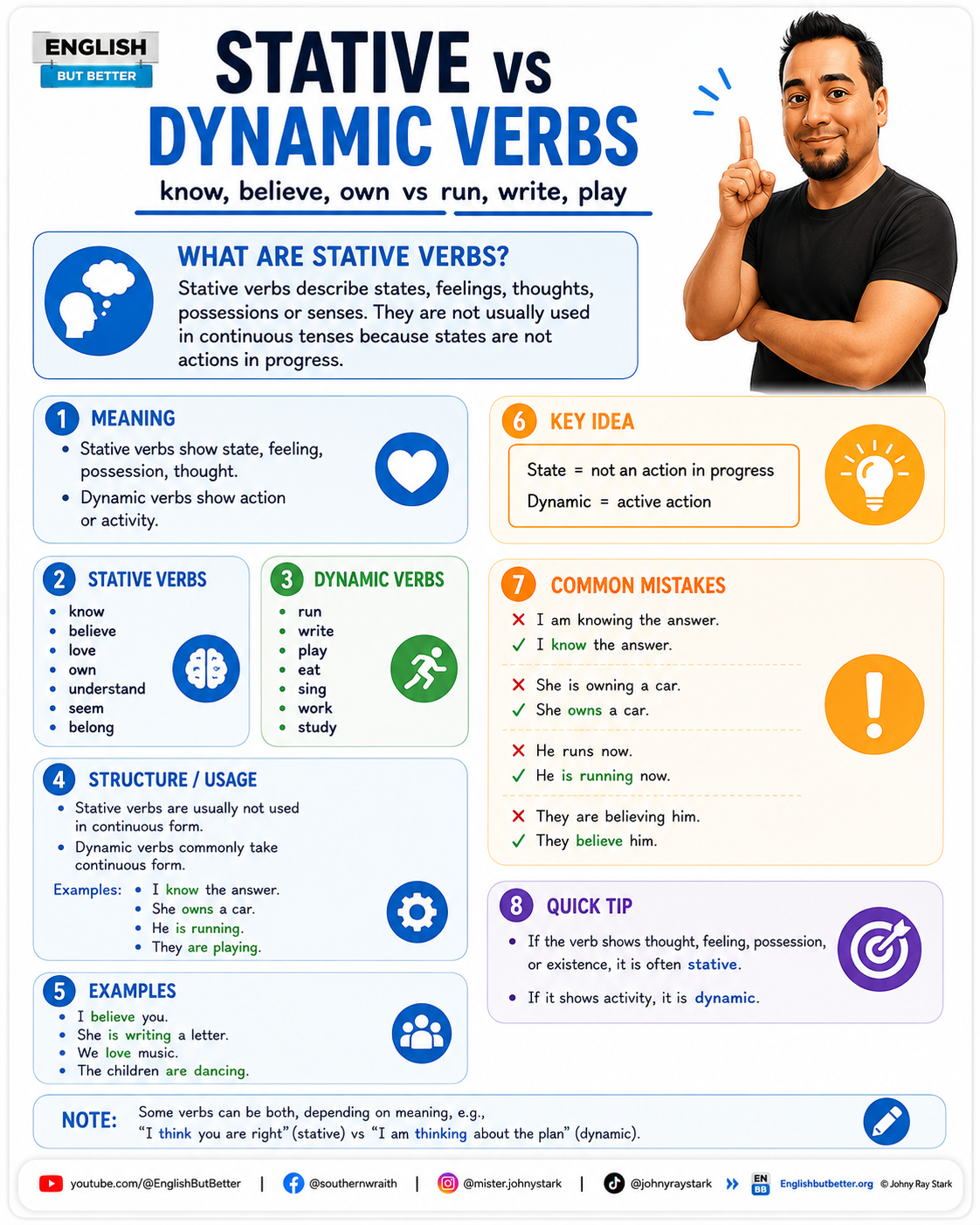
What are stative verbs?
Stative verbs describe a state (a condition that doesn't change moment to moment), not an action. Because they don't describe ongoing action, they are NOT normally used in the -ing continuous form.
✗ "She is wanting coffee." → ✓ "She wants coffee."
✗ "Are you liking this song?" → ✓ "Do you like this song?"
Common stative verbs by category
| Category | Verbs |
|---|---|
| Mind & thinking | know · believe · think (= opinion) · understand · remember · forget · realise · mean · recognise |
| Feelings & emotions | love · like · hate · prefer · want · need · wish · enjoy (usually) |
| Senses | see · hear · smell · taste · feel · sound · look (= appear) |
| Existence & possession | be · have (= possess) · own · belong · contain · consist · exist · include |
Verbs That Can Be Both Stative and Dynamic
Some verbs change category depending on what they mean in the sentence — when they describe a state, perception, or opinion, they're stative (no continuous form); when they describe a deliberate action or process, they're dynamic (continuous form is fine).
BE
Stative: a permanent or inherent characteristic — what someone or something simply is. "She is tall." · "He is kind."
Dynamic (be + -ing = "being"): deliberate or temporary behaviour — how someone is choosing to act right now, not their permanent nature. "He is being rude." (= he's behaving that way now) · "Why are you being so difficult today?"
HAVE
Stative: possession, relationships, or characteristics. "I have a car." · "She has two brothers."
Dynamic: an action or experience — things you can actively do. "I'm having lunch." · "We're having a great time."
SEE
Stative: perceive with your eyes, or understand. "I see the mountains from here." · "I see what you mean."
Dynamic: meet, date, or visit someone (often a doctor or a romantic partner). "I'm seeing a specialist next week." · "They've been seeing each other for months."
SMELL
Stative: an inherent quality perceived through the nose. "This soup smells delicious."
Dynamic: the deliberate action of sniffing something. "She's smelling the flowers to see if they're real."
TASTE
Stative: an inherent quality. "This cake tastes amazing."
Dynamic: the deliberate action of sampling food to check its flavour. "The chef is tasting the sauce before serving it."
FEEL
Stative: a physical quality, or an opinion/belief. "The blanket feels soft." · "I feel this is a mistake."
Dynamic: the deliberate action of touching something to sense it. "She's feeling the fabric to check the quality."
THINK
Stative: an opinion or belief. "I think she's right."
Dynamic: the ongoing mental process of considering something. "I'm thinking about my next vacation."
LOOK
Stative (= appear/seem): "You look tired."
Dynamic: the physical action of directing your eyes somewhere. "She's looking at the menu."
APPEAR
Stative (= seem): "He appears confident, even though he's nervous."
Dynamic: come into view, or perform publicly. "The sun is appearing from behind the clouds." · "She's appearing in a new movie this year."
| Verb | Stative meaning | Dynamic meaning |
|---|---|---|
| BE | Permanent/inherent characteristic | Deliberate/temporary behavior |
| HAVE | Possession/relationship | Action/experience |
| SEE | Perceive with eyes / understand | Meet/date/visit |
| SMELL | Inherent quality/perception | Deliberate sniffing |
| TASTE | Inherent quality | Deliberate sampling |
| FEEL | Physical quality / opinion-belief | Deliberate touching |
| THINK | Opinion/belief | Process of considering |
| LOOK | Appear/seem | Physical act of looking |
| APPEAR | Seem | Come into view / perform |
Exercises
Exercise 1 — Multiple Choice
Choose the correct form.
1. I ______ you're right about this.
2. Sorry, I can't talk now — I ______ about what you said earlier.
3. This milk ______ strange. Did you check the date?
4. She ______ the perfume before buying it.
5. He never causes trouble. Today, though, he ______ really difficult.
6. Careful, the stove ______ hot right now.
7. I ______ this decision is a mistake, even if I can't explain why.
8. My cousin ______ in a TV commercial next week.
Exercise 2 — Complete the Text
Complete each gap with the correct form (simple or continuous) of the verb given.
It's Sunday afternoon, and Marco (cook) dinner for his family. The kitchen (smell) amazing — like garlic and fresh basil. Right now, Marco (taste) the sauce to check if it needs more salt. "Hmm," he says, "I (think) it's perfect now." His daughter walks in and (feel) the bread on the counter. "It (feel) warm! Can we eat now?" Marco (see) that she's hungry, so he says, "Almost — I (think) about the timing right now, give me five minutes." Later, his brother arrives. "You (be) really patient today," Marco jokes, "usually you're the impatient one!" His brother laughs: "I know, I (be) extra calm because it's Sunday."
Exercise 3 — Error Correction
Find the error in each sentence and write the corrected sentence.