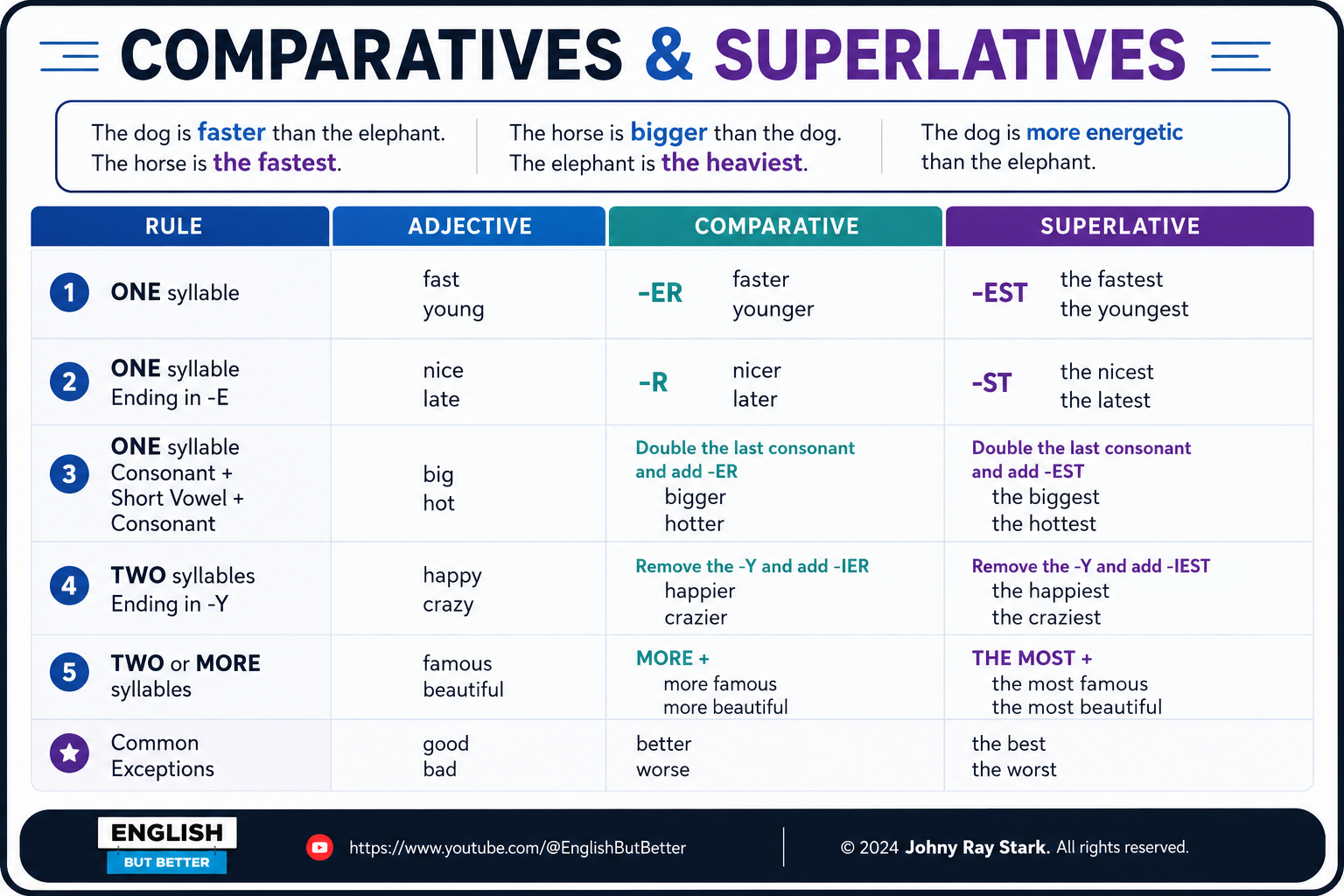
How to form
| Adjective type | Comparative | Superlative | Examples |
|---|---|---|---|
| Short (1 syllable) | adj + -er | the + adj + -est | tall → taller → the tallest |
| Short ending -e | adj + -r | the + adj + -st | large → larger → the largest |
| Short CVC (consonant-vowel-consonant) | double consonant + -er | double consonant + -est | big → bigger → the biggest hot → hotter → the hottest |
| Short ending -y | -y → -ier | -y → -iest | happy → happier → the happiest |
| Long (2+ syllables) | more + adj | the most + adj | interesting → more interesting → the most interesting |
Irregular forms
| Adjective | Comparative | Superlative |
|---|---|---|
| good | better | the best |
| bad | worse | the worst |
| far | further / farther | the furthest / farthest |
| little | less | the least |
| much / many | more | the most |
When Not to Use Comparative or Superlative Forms
Some adjectives already describe an absolute, all-or-nothing quality — something either is that way completely, or it isn't. These are called absolute adjectives, and they normally don't take -er/-est or more/most, because you can't have "more" of something that's already total or complete.
✗ "This is more perfect than that one." → ✓ "This one is perfect."
✗ "That's the most impossible task I've ever seen." → ✓ "That's an impossible task."
Exercises
Exercise 1 — Multiple Choice
Choose the correct form.
1. My bag is ___ than yours.
2. She is ___ student in the school.
3. This film is ___ I expected.
4. Today is ___ day of the year!
Exercise 2 — Read and Match
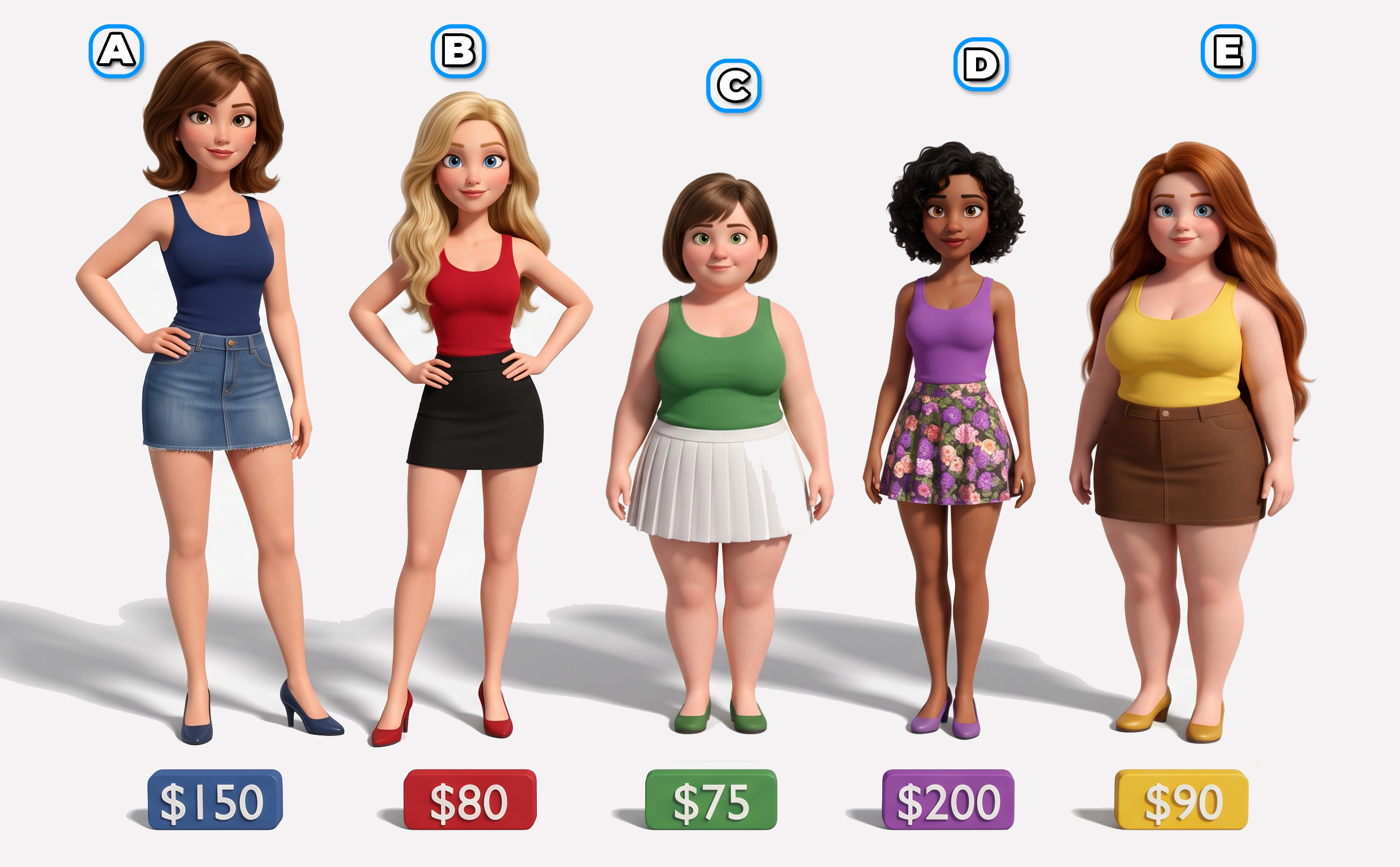
Read the clues below. Then match each name to a letter (A–E). Each letter can only be used once.
Ann is taller than Jane, Mary and Molly, but Sarah is taller than Ann.
Molly is fatter than Ann, Sarah and Mary, but Jane is fatter than Molly.
Ann's hair is longer than Mary's hair and Molly's hair, but Jane's hair is longer than Ann's hair.
Sarah's shoes are more expensive than Jane's shoes, Molly's shoes and Ann's shoes, but Mary's shoes are more expensive than Sarah's shoes.
Exercise 3 — Write the Adjective
Write the base adjective for each comparative or superlative form.
2. lovelier →
3. more interesting →
4. the happiest →
5. earlier →
6. drier →
7. the most famous →
8. friendlier →
9. fatter →
10. more exciting →
Exercise 4 — Complete the Sentences
Complete each sentence with is or are plus the comparative form of a word from the box. Each word is used once.
2. Gold than paper.
3. Sharks than dolphins.
4. Chinese than English.
5. June and July than April and May.
6. A funfair than school.
7. Vegetables than sweets.
Exercise 5 — Word Order
Put the words in the correct order to make a sentence.
Exercise 6 — Complete the Table
Complete the table with the missing forms. Don't forget than or the where needed.
| Adjective | Comparative | Superlative |
|---|---|---|
| good | ||
| nicer | ||
| the most annoying | ||
| cheaper | ||
| expensive | ||
| bad | ||
| bigger | ||
| the tallest | ||
| prettier | ||
| fast | ||
| happier | ||
| the smallest | ||
| sadder | ||
| boring |