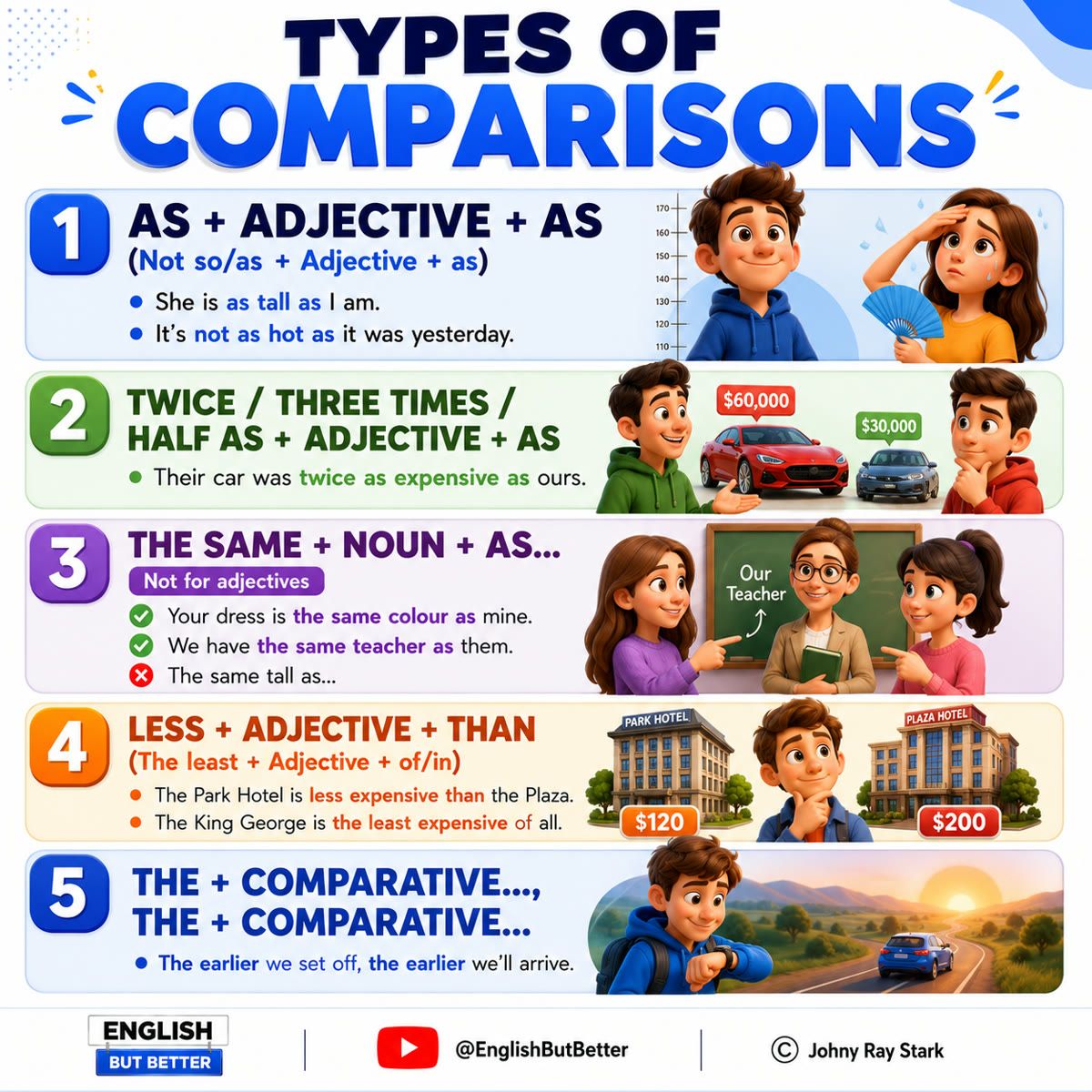
Making comparisons in English goes far beyond just adding -er or using more. Precise, natural-sounding English also needs ways to express equality, exact proportions, identical properties, lower degree, and simultaneous change.
These five structures give you that extra precision — useful for describing data, comparing options, and expressing more nuanced opinions than a simple comparative can.
| Structure | Purpose | Focus |
|---|---|---|
| as + adjective + as | Equal degree | Adjectives / qualities |
| twice / three times / half + as + adj + as | Proportions & ratios | Quantifiable comparisons |
| the same + noun + as | Identical properties | Nouns / categories |
| less + adjective + than | Lower degree | Comparative inferiority |
| the + comparative…, the + comparative… | Correlative change | Interdependent variables |
1. Equal Comparisons
as + adjective + asUse as + adjective + as to say that two things share exactly the same degree of a quality. In the negative — not as/so + adjective + as — it means the first thing has less of that quality than the second.
She is as tall as I am. (Both people are exactly the same height.)
It's not as hot as it was yesterday. (Today is cooler than yesterday.)
2. Proportional & Fractional Comparisons
twice / three times / half + as + adjective + asUse a multiplier or fraction before as + adjective + as to say exactly how much more or less of a quality one thing has, instead of just a general comparative.
Their car was twice as expensive as ours. (Car A = $60,000; Car B = $30,000 — Car A costs double.)
Her new laptop is half as heavy as her old one. (The new one weighs half as much.)
3. Identical Noun Comparison
the same + noun + asWhile as...as modifies adjectives (qualities), the same...as modifies nouns (categories, properties, or features). It says that two things share an identical specification.
Your dress is the same colour as mine. (Comparing the noun "colour", not the adjective "red" or "blue".)
We have the same teacher as them. (An identical person, shared by both groups.)
✗ "She is the same tall as me."
✓ "She is as tall as me." (adjective approach)
✓ "She is the same height as me." (noun approach)
4. Comparisons of Inferiority
less + adjective + than · the least + adjective + of/inThe mirror image of the comparative/superlative you already know: instead of a higher degree, these say something has a lower degree of a quality (comparative of inferiority) or the lowest degree in a whole group (superlative of inferiority).
The Park Hotel is less expensive than the Plaza. (Park Hotel = $120/night; Plaza = $200/night.)
The King George is the least expensive of all. (The lowest price out of every option.)
5. Correlative Comparisons
the + comparative…, the + comparative…Also called double comparatives, this structure shows that a change in one thing causes a matching change in another. It can move in any direction — not just "more, more":
- More … more: The more you study, the more you learn.
- More … less: The older we get, the less innocent we become.
- Less … less: The less you worry, the less stressed you feel.
- Less … more: The less money we spend, the more savings we have.
The dirtier the environment is, the less healthy it becomes. (More pollution → lower health.)
The earlier we set off, the earlier we'll arrive. (A change in departure time causes a matching change in arrival time.)
Exercises
Exercise 1 — Equal Comparisons
Complete each sentence with as + adjective + as, using the adjective in brackets.
2. Her cooking isn't my grandmother's. (good)
3. This bag is that one. (heavy)
4. The film wasn't I expected. (exciting)
5. Our house is theirs. (big)
6. The real exam wasn't the mock exam. (hard)
Exercise 2 — Proportional Comparisons
Look at the facts, then complete the sentence with a multiplier + as + adjective + as (e.g. twice as big as, half as long as).
2. City A: 500,000 people. City B: 1,500,000 people. City B is City A. (crowded)
3. Recipe A: 2 cups of sugar. Recipe B: 1 cup of sugar. Recipe B is Recipe A. (sweet)
4. Highway speed: 120 km/h. Town speed: 30 km/h. The highway speed is the town speed. (fast)
5. My rent: $300. Her rent: $900. Her rent is mine. (expensive)
Exercise 3 — as...as or the same...as?
Complete each sentence with either as + adjective + as or the same + noun + as, using the word in brackets.
2. This exercise isn't the last one. (difficult)
3. We go to you. (gym)
4. His answer was mine. (long)
5. The two paintings are the originals. (size)
6. Her opinion is his. (interesting)
Exercise 4 — Comparisons of Inferiority
Complete each sentence with less + adjective + than or the least + adjective, using the word in brackets.
2. Of every hotel in town, the King George has the lowest price. The King George is of all.
3. Skiing causes more accidents than swimming. Swimming is skiing.
4. Almost nobody in this class chose to study Icelandic. Icelandic is language in the class.
5. The subway is used far more than city buses. Buses are the subway.
Exercise 5 — Correlative Comparisons
Rewrite the two facts as one sentence using the + comparative…, the + comparative…
Exercise 6 — Mixed Review
Choose the correct sentence.
1.
2.
3.
4.
5.
6.