Form
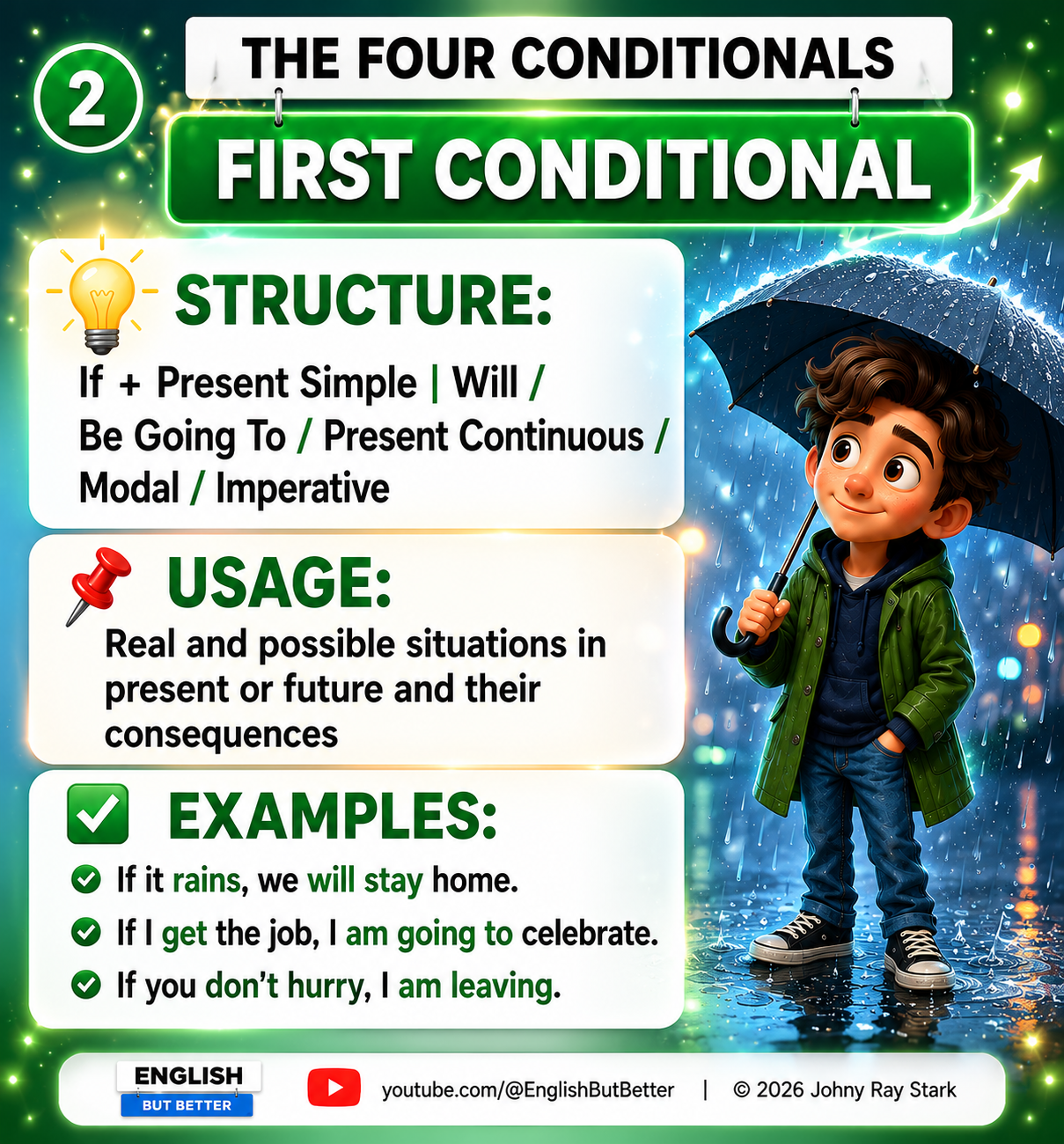
Formula: If + present simple → will / be going to / present continuous / modal / imperative
Will is just the most common result form — the first conditional accepts several others too (see Variations below).
| If clause (condition) | Main clause (result) |
|---|---|
| If it rains, | I will take an umbrella. |
| If you study hard, | you 'll pass the exam. |
| If she doesn't hurry, | we 'll miss the bus. |
| If I see him, | I will tell him. |
Never use will in the if clause:
✓ "If it rains, I will go home." ✗ "If it will rain, I will go home."
Clause order:
The result clause can come first (no comma needed): "I will call you if I need help."
Use
The first conditional describes real, possible situations in the future. The speaker believes the condition could genuinely happen.
| Use | Example |
|---|---|
| Future possibility | If we leave now, we 'll arrive on time. |
| Warning / threat | If you touch that, you 'll regret it! |
| Promise | If you help me, I 'll buy you dinner. |
| Advice (imperative result) | If you feel sick, see a doctor. |
Variations in the result clause
The result clause doesn't always need will. Other forms are possible:
| Result form | Example |
|---|---|
| will + infinitive | If it rains, we will stay home. |
| be going to + infinitive | If I get the job, I am going to celebrate. |
| present continuous | If you don't hurry, I am leaving. (decision already made) |
| can + infinitive | If you finish early, you can leave. |
| may/might + infinitive | If she calls, I might go. (less certain) |
| imperative | If you're tired, go to bed! |
Exercises
Choose the correct first conditional form.
1. If it ___ tomorrow, we'll cancel the picnic.
2. If you don't hurry, we ___ the bus.
3. I'll lend you some money if you ___ me back next week.
4. If she calls me, I ___ you immediately.