Form
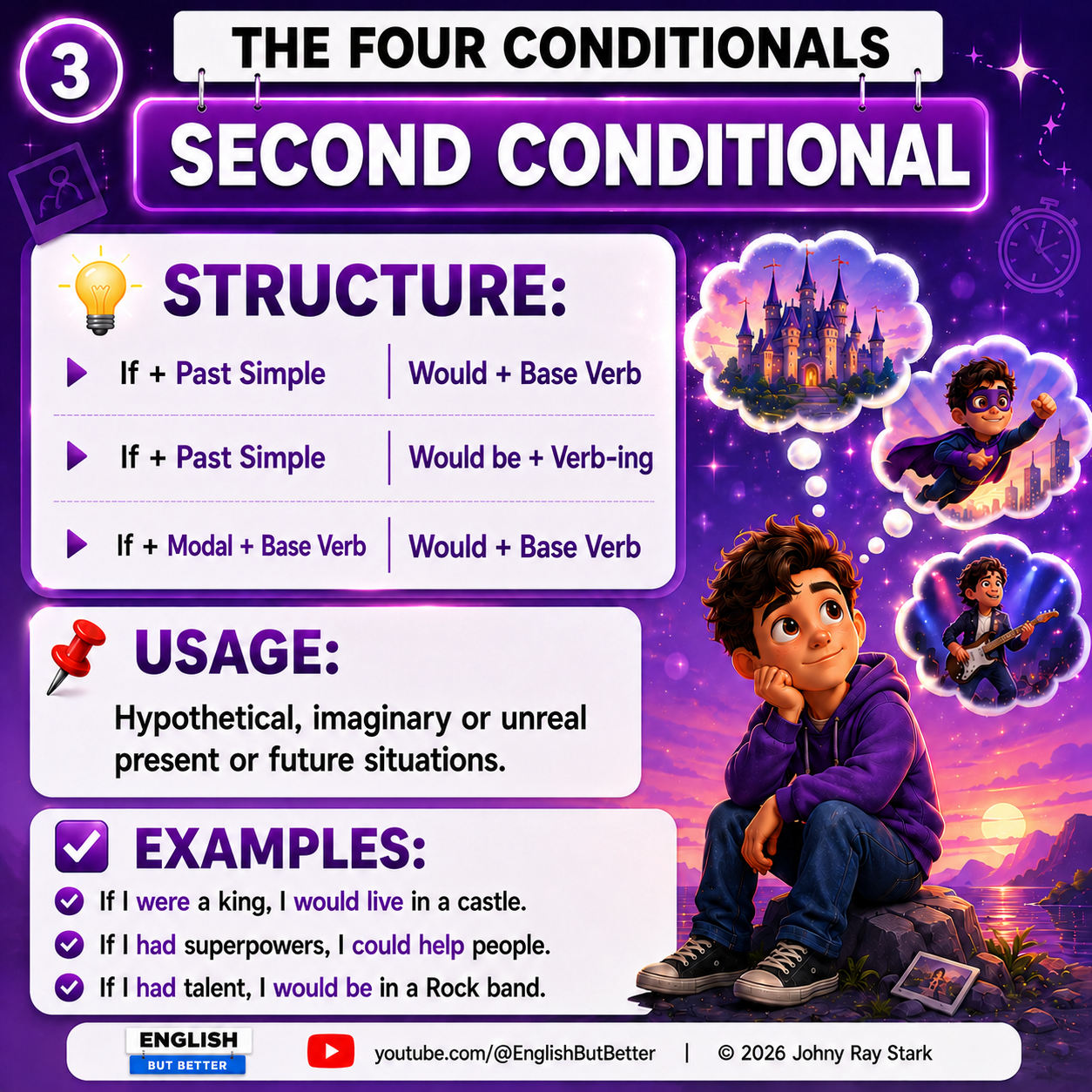
Formula: If + past simple → would + base verb / would be + verb-ing / modal + base verb (could, might, should, must, had better)
The result clause isn't limited to plain "would" — it can also be would be + -ing (an imagined action in progress) or another modal expressing a different degree of certainty or advice.
| If clause (hypothetical condition) | Result type | Main clause (imagined result) |
|---|---|---|
| If I had more money, | would + base verb | I would buy a house. |
| If I were you, | would + base verb | I wouldn't do that. |
| If I had time, | would be + -ing | I would be studying right now. |
| If it weren't raining, | would be + -ing | we would be swimming in the lake. |
| If I had superpowers, | modal + base verb | I could help people. |
| If he studied more, | modal + base verb | he might pass the exam. |
were not was:
In formal/standard English, use were for all subjects in the if clause: "If I were rich…" / "If she were here…" In informal speech, "was" is also common: "If I was you…"
would → 'd:
Short form: "I 'd buy" / "She 'd go" / "They wouldn't agree."
Use
The second conditional describes situations that are imaginary, unlikely or impossible in the present or future.
| Use | Example |
|---|---|
| Imaginary / hypothetical present | If I lived in Paris, I would visit the Louvre every week. (I don't live in Paris) |
| Unlikely future | If it snowed in summer, everyone would be shocked. (very unlikely) |
| Advice (If I were you…) | If I were you, I would apologise. |
| Wishes and dreams | If I could fly, I would visit every country. |
First vs Second Conditional
| First Conditional | Second Conditional |
|---|---|
| Real / possible future situation | Hypothetical / unlikely situation |
| If it rains, I will stay in. (rain is possible today) |
If it rained every day, I would move away. (hypothetical, not likely) |
| If I find a good job, I 'll move. (realistic future plan) |
If I won the lottery, I 'd buy a yacht. (dream, unlikely) |
Exercises
Choose the correct form. First or second conditional?
1. If I ___ a million euros, I'd travel the world.
2. If she studies tonight, she ___ the test.
3. If I ___ you, I would talk to him directly.
4. If dogs ___ talk, what would yours say?