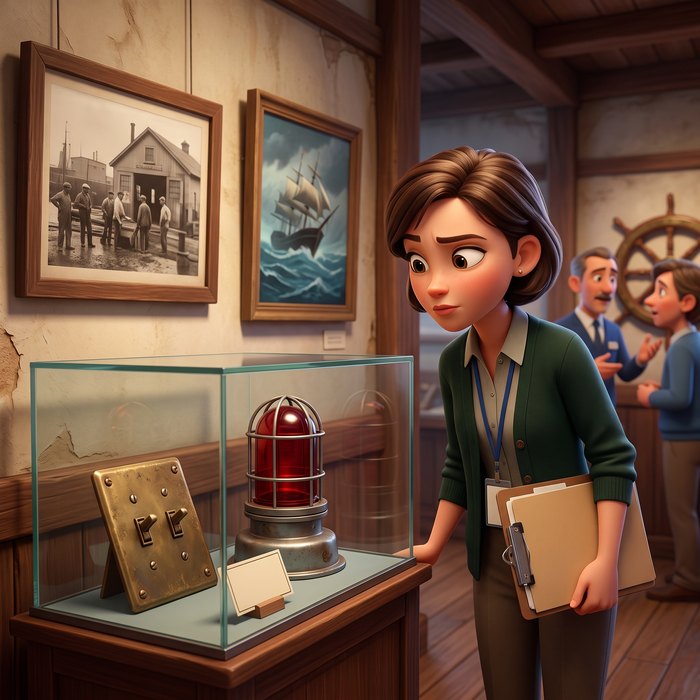
Visitors at Bellwether Maritime Museum gather monthly around a brass switch plate. Its label reads: “The switch June Ellis pulled at 8:47 on the night of the 1956 storm saved fourteen people from the harbour.” Children ask about the mark left by her thumb, but there is no clear mark. It is the museum’s most popular object.
While updating the gallery, curator Mara Venn found an invoice: the plate was installed in 1961, five years after the storm. A maintenance note described it as a replacement control plate, and the model number matched the invoice. The object visitors loved could not have been the switch June used that night.
That did not prove June had not raised the alarm. The harbour log recorded the warning light at 8:47 and listed fourteen people brought ashore, but left the operator’s name blank. In a 1978 radio interview, June said she had been alone in the control room and pulled the handle. Her account matched the time, but came more than twenty years later. No surviving record named her as the operator.
Mara realised the display had combined three things into one claim: a time in the log, June’s later account, and a plate installed years afterwards. The story had not been disproved. The evidence simply did not support the certainty of the wording.
Guide Tomás Reed argued against changing it. He had seen families visit the case; some said their parents were on the boats. “They don’t come to inspect an invoice,” he said. “They come because someone acted quickly when it mattered.” The case drew more comments than any other item in the gallery. Yet what would visitors think if they discovered the installation date?
The local history group wanted the label corrected, but its chair, Nia Price, warned Mara not to replace one simple story with another. “We know when the plate was installed. We don’t know who turned the handle in 1956.” The group had collected oral histories because few official records survived from the harbour’s early years. June’s interview was a source, not a record made that night. That did not make it worthless; it made it different.
Mara could remove June’s name, keep the old wording, or separate what the museum knew from what it believed. The final label would keep June’s account while stating clearly what remained unknown. The new label explained that the plate dated from 1961, while the harbour log placed the warning light at 8:47 and listed fourteen people brought ashore. It added that June later said she had pulled the handle. The last line read: “The surviving records do not identify who operated the switch or what role the signal played in the rescue.”
Some visitors were disappointed. One man asked whether the museum was saying June had lied. Mara said the records could not prove that the plate was hers that night or answer every question about her role. He read the label again, then pointed to a photograph captioned “Harbour staff outside the control building, on the night of the storm”. June stood outside with two other workers. “So she was there,” he said. “The photograph places her at the site,” Mara replied, “but it does not show who operated the switch.” He nodded, still unconvinced.
This is a fictional case written for English But Better.