Form
Formula: If / When + present simple → present simple / can (be able to) / imperative
The result clause isn't always a plain present simple statement — it can also be an ability (can) or a direct instruction (imperative).
| If / When clause | Result type | Result clause |
|---|---|---|
| If you heat water to 100°C, | present simple | it boils. |
| When I am tired, | present simple | I make mistakes. |
| If you study hard, | can (ability) | you can pass the exam. |
| If you heat ice, | can (ability) | it can turn into water. |
| If you need help, | imperative | call me. |
| If you see smoke, | imperative | leave the building immediately. |
if vs when:
Both work in the zero conditional. If suggests a condition that may or may not happen. When suggests it always or regularly happens: "When I drink coffee, I feel better." (always true)
Clause order:
The if/when clause can come first or second. If it comes second, no comma is needed: "Water boils if you heat it to 100°C."
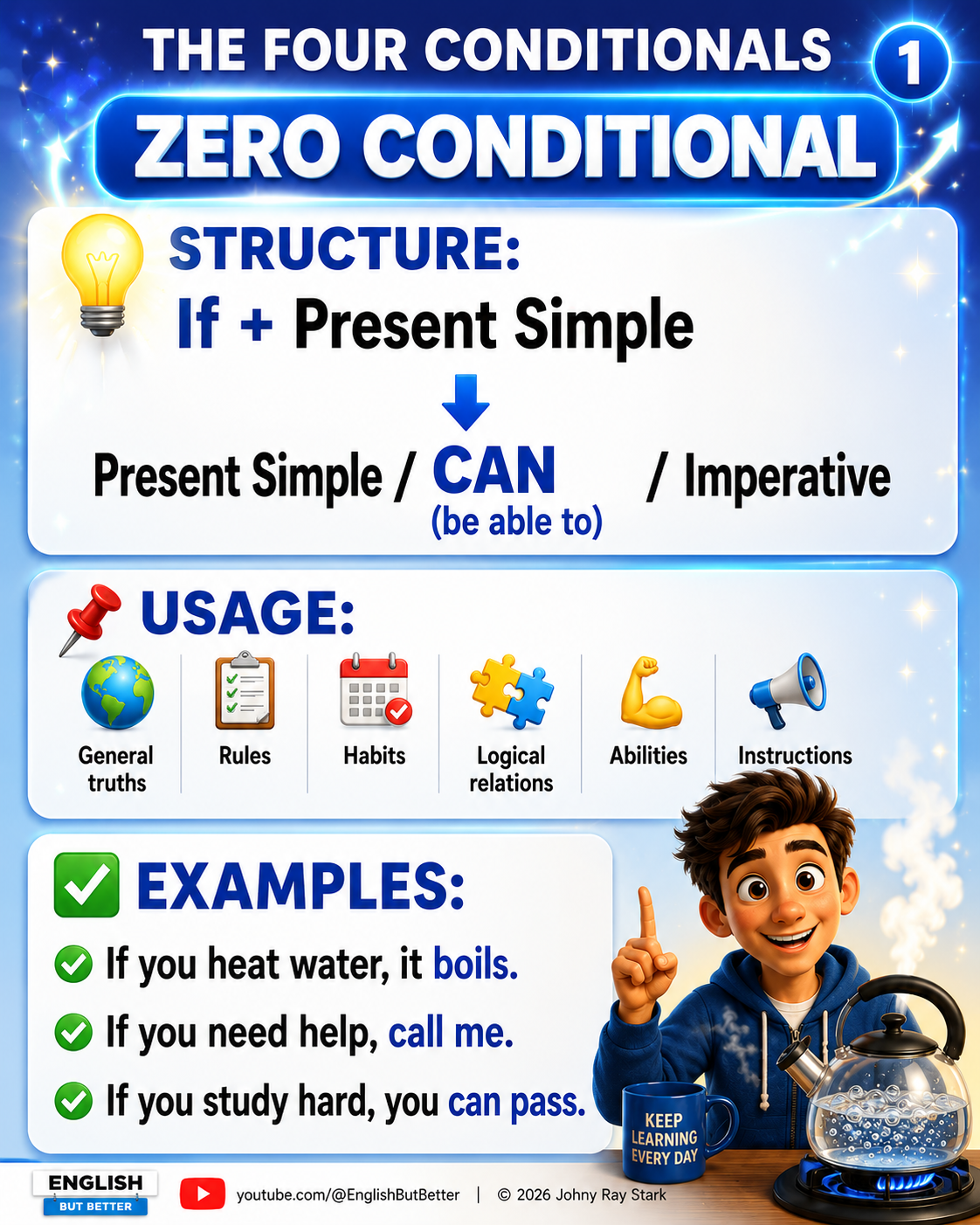
When to use the zero conditional
| Use | Example |
|---|---|
| General truths | If you mix red and blue, you get purple. |
| Rules | If you don't wear a seatbelt, you get a fine. |
| Habits | When I exercise, I feel much better. |
| Logical relations | If today is Monday, tomorrow is Tuesday. |
| Abilities | If you study hard, you can pass the exam. |
| Instructions | If the alarm sounds, everyone leaves the building. |
Three conditionals — quick overview
| Conditional | Form | Meaning |
|---|---|---|
| Zero | if + present, present | Always true — facts & general truths |
| First | if + present, will | Real / likely future possibility |
| Second | if + past, would | Hypothetical / unreal present situation |
Exercises
Complete the zero conditional. Choose the correct form.
1. If you ___ water below 0°C, it freezes.
2. Plants die if they ___ enough light.
3. If you press this button, the machine ___.
5. If you practise every day, you ___ speak fluently within a year.
6. If you feel dizzy, ___ down immediately.
4. When I'm stressed, I usually ___ (eat) too much.