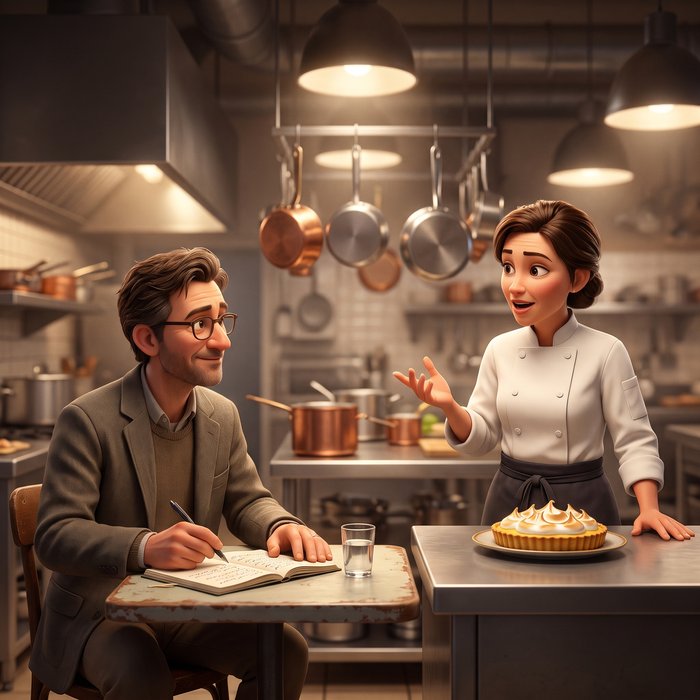
Ghostwriter: Your publisher wants the first chapter to explain how you became a chef. You said you learned everything from your grandmother.
Chef: I did. She was extraordinary. She could make a feast from almost nothing.
Ghostwriter: Wonderful. Tell me about the first dish you cooked with her.
Chef: A perfect lemon tart. I was eight, perhaps nine. The kitchen smelled of butter and fresh lemons.
Ghostwriter: And what went wrong?
Chef: Nothing went wrong. It was a perfect tart.
Ghostwriter: Every memorable story needs a little tension. Did you burn it? Drop it? Forget the sugar?
Chef: I may have put in too much salt.
Ghostwriter: There we are. What did your grandmother say?
Chef: She tasted it, looked at me, and said, "Well, darling, this is why we taste as we go."
Ghostwriter: That's lovely. But the publisher wants something more dramatic. Could the tart have ruined a family celebration?
Chef: It did not ruin anything. We laughed, made another one, and ate the first tart ourselves.
Ghostwriter: I like that. It sounds like a real memory rather than a publicity story.
Chef: Real memories don't always sell books. People want a transformation, a crisis, a moment when the future becomes obvious.
Ghostwriter: Then perhaps the transformation is smaller. You learned that mistakes can be corrected, and that cooking is not a performance in which every dish must be perfect.
Chef: That is a very reasonable lesson. I'm not sure it belongs in a celebrity cookbook.
Ghostwriter: Why not? Your restaurants are famous for encouraging young cooks to experiment. Your own story could explain where that philosophy began.
Chef: You make it sound as if I've been consistent all my life.
Ghostwriter: You haven't?
Chef: When I opened my first restaurant, I threw a plate at the wall because a sauce split. My grandmother would have been horrified.
Ghostwriter: Now that's a story worth exploring. What happened afterwards?
Chef: The kitchen went silent. Then my sous-chef handed me a cloth and said I could clean up my own temper.
Ghostwriter: And did you?
Chef: Eventually. He was right. I apologised, and we worked out how to fix the sauce.
Ghostwriter: That gives us conflict, consequence, and a change in behaviour. We don't need to invent a disaster.
Chef: Fine. But leave out the part where I cried.
Ghostwriter: Did you?
Chef: No. But leave it out anyway.
Fiction note: All people, places and events in this dialogue are fictional.