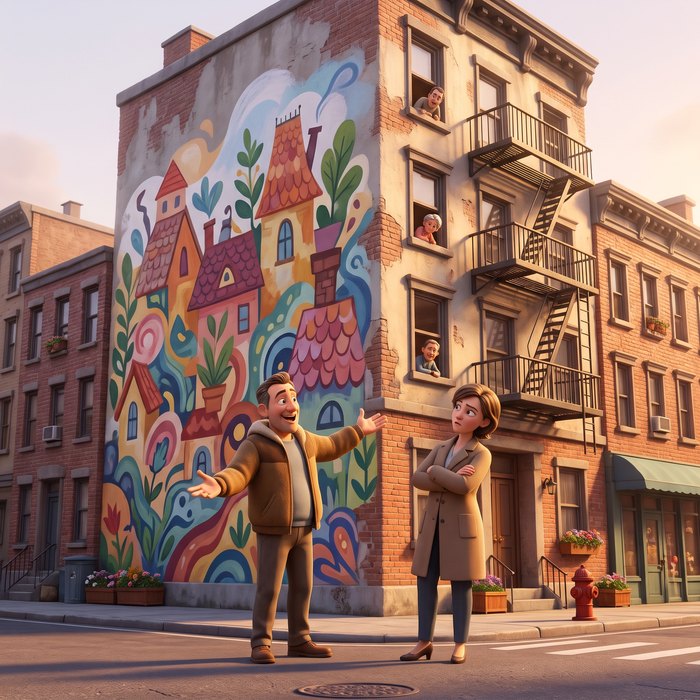
Elena: I still can't believe they painted the whole eastern wall without asking anyone who lives here.
Martin: They got permission from the building committee. That isn't exactly a midnight attack with paintbrushes.
Elena: The committee approved a proposal. Nobody showed us the finished design. There's a difference.
Martin: And now the wall is the most interesting thing on this street. People have started stopping to look at it.
Elena: Visitors stopping to look isn't the same as residents wanting it. The mural makes our block look like a fashionable arts district, which it isn't.
Martin: Perhaps it could become one. Neighbourhoods don't have to remain frozen in whatever decade their oldest residents prefer.
Elena: I don't want the place frozen. I want people who live here to have a say in what changes.
Martin: Fair enough. But if every change needs unanimous approval, nothing will ever happen.
Elena: I'm not asking for unanimity. I'm asking for consultation before the paint is permanent.
Martin: The committee thought the design was harmless. It shows rooftops, plants, and the old water tower. What's offensive about that?
Elena: Nothing is offensive. That's almost the point. The mural is pleasant enough to make disagreement sound unreasonable. But it tells a tidy story about a neighbourhood that is far more complicated.
Martin: What story would you tell instead?
Elena: That people here work different shifts, speak different languages, argue over parking, look after one another, and still can't agree on a mural. Not exactly a tourist slogan.
Martin: It might be more honest, though not particularly easy to paint.
Elena: I'm not demanding that the wall become a documentary. I just dislike being told that a cheerful image represents all of us.
Martin: I can see that. Still, the artist didn't claim to represent everyone. They were asked to make something that would brighten the street.
Elena: Then the committee should say that. A decoration is one thing; a statement about who we are is another.
Martin: So perhaps the real problem isn't the mural. It's the announcement calling it “the true face of our community.”
Elena: Exactly. The paint doesn't speak for us. The people describing it do.
Martin: I'll admit, that phrase was rather ambitious for a wall full of rooftops.
Elena: And now you're beginning to understand why I object.
Fiction note: All people, places and events in this dialogue are fictional.