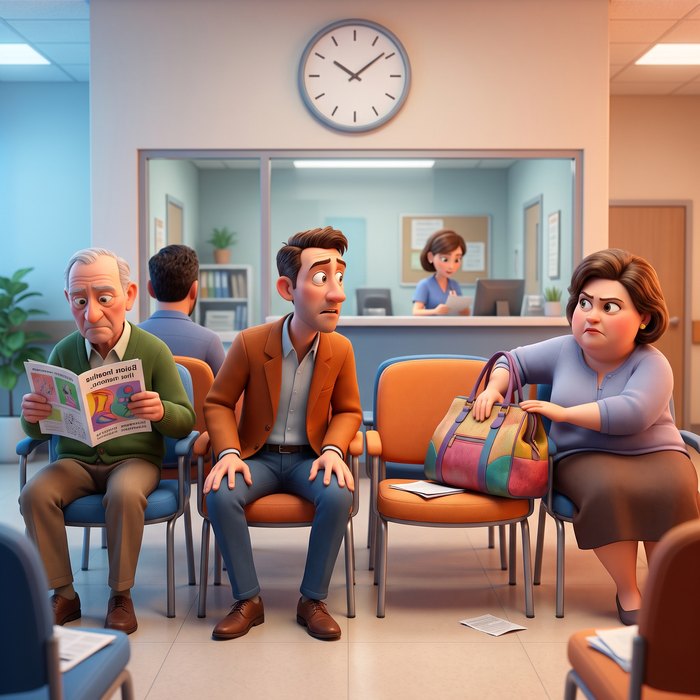
Here, in the fluorescent habitat of the public waiting room, a familiar species gathers beneath the wall clock. The appointment-seeking human has arrived early, sometimes excessively so, believing that punctuality may influence the speed of the ecosystem. It rarely does.
Observe the newcomer. They enter with the cautious optimism of an animal approaching an unfamiliar watering hole. First comes the scan for available seating. Then the subtle calculation of distance from the reception desk, the door, and the person who appears to be coughing with professional commitment. Having selected a chair, the newcomer places a bag on the adjacent seat, establishing a temporary territorial boundary. This boundary may be defended even when the room is crowded.
The established inhabitants display more specialised behaviours. One individual checks a phone every eleven seconds, although no message has arrived since the previous inspection. Another studies a magazine with the intense concentration usually associated with emergency surgery. A third watches the receptionist, attempting to determine whether the movement of a clipboard signals progress or merely a change of scenery.
The receptionist remains the dominant figure in this environment. Their brief appearance can produce an immediate collective response: backs straighten, phones lower, and several faces adopt expressions of neutral readiness. When a name is called, the selected individual rises with the startled dignity of a creature that has forgotten its own name. The others look up, then return to their screens, relieved that the unpredictable event has not involved them.
As the minutes pass, social rules become more complicated. A person who arrived later may be called first, causing silent calculations and a restrained study of the appointment system. Few challenge the apparent injustice. Most prefer to preserve energy for the encounter ahead, where their symptoms, documents, or explanations will need to be presented in a limited period.
Eventually, the waiting room teaches its inhabitants a peculiar form of cooperation. They exchange glances when the clock seems to stop, offer a tissue without discussion, and silently acknowledge the shared absurdity of hearing the same advertisement for private healthcare for the sixth time. No formal community has been established, yet a temporary alliance emerges from mutual discomfort.
Then a door opens, and the entire population becomes alert. A name is spoken. One human departs. The others watch the empty space left behind, wondering whether this is evidence of progress or simply the beginning of another cycle. In this habitat, hope survives not because the system is predictable, but because every closed door might eventually open.
Fiction note: All people, places and events in this text are fictional.