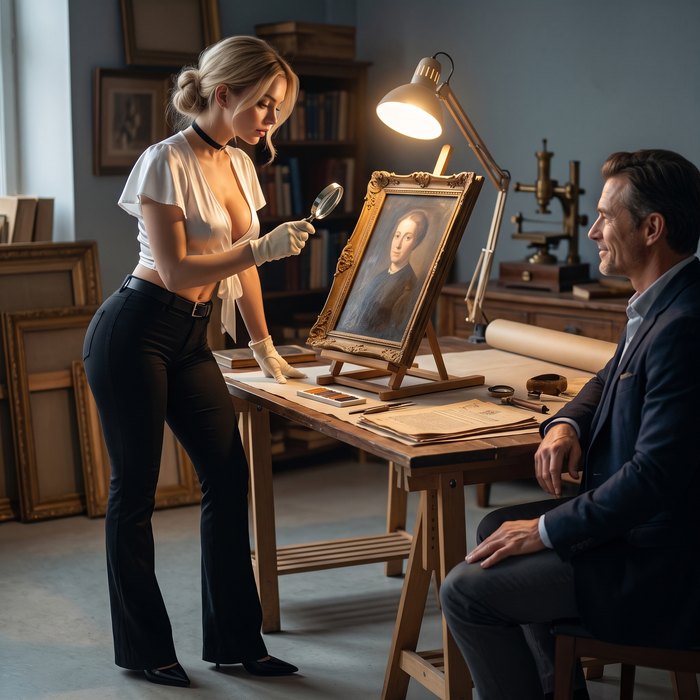
Appraiser: You say this portrait belonged to your great-aunt?
Visitor: That's right. She kept it in her study for decades. We always believed it was a minor work by Bellori.
Appraiser: And you would like me to confirm the attribution?
Visitor: If the evidence supports it, naturally. I'm not asking you to invent a masterpiece.
Appraiser: A sensible position. May I ask where the painting was stored?
Visitor: In a dry room, away from direct sunlight. She was very careful with her possessions.
Appraiser: Yet the canvas has a pattern of moisture damage that suggests it spent time in a damp environment.
Visitor: Perhaps the room flooded before she acquired it.
Appraiser: Possible. But the frame is also inconsistent with the period. Its wood has been artificially aged, and the fastenings are modern.
Visitor: Frames are replaced all the time. Surely that tells you very little about the painting itself.
Appraiser: Correct. A later frame does not prove a painting is false. But it means we must examine the other evidence more carefully. The pigment around the signature is especially interesting.
Visitor: Interesting in what way?
Appraiser: The signature sits beneath a layer of varnish, but the surrounding paint shows traces of a solvent that would have disturbed the varnish if the signature had been added in the usual way. Someone may have applied the signature before treating the surface, then altered the surrounding area to make the sequence appear older.
Visitor: You're suggesting deliberate deception based on a few chemical traces?
Appraiser: I'm suggesting that the physical evidence conflicts with the story we've been given. I would need laboratory analysis before reaching a final conclusion.
Visitor: My family has always considered it authentic. Are you saying my great-aunt was involved?
Appraiser: Not at all. She may have been deceived herself. Provenance can be incomplete without being fraudulent, and ownership history is not the same as authorship.
Visitor: If you cannot prove who painted it, what exactly can you tell me?
Appraiser: I can tell you that the attribution is unsupported, the materials require further testing, and the current evidence does not justify selling it as a Bellori. I can also document every reason for that conclusion.
Visitor: That could make it difficult to sell.
Appraiser: My task is not to make an object easier to sell. It is to assess what the evidence can honestly support.
Visitor: Then perhaps we should leave the laboratory out of it.
Appraiser: If you prefer not to investigate further, that is your choice. But my report will still describe the concerns we've identified.
Visitor: You are a very inconvenient person.
Appraiser: That is not the first time evidence has been accused of poor manners.
Fiction note: All people, places and events in this dialogue are fictional.