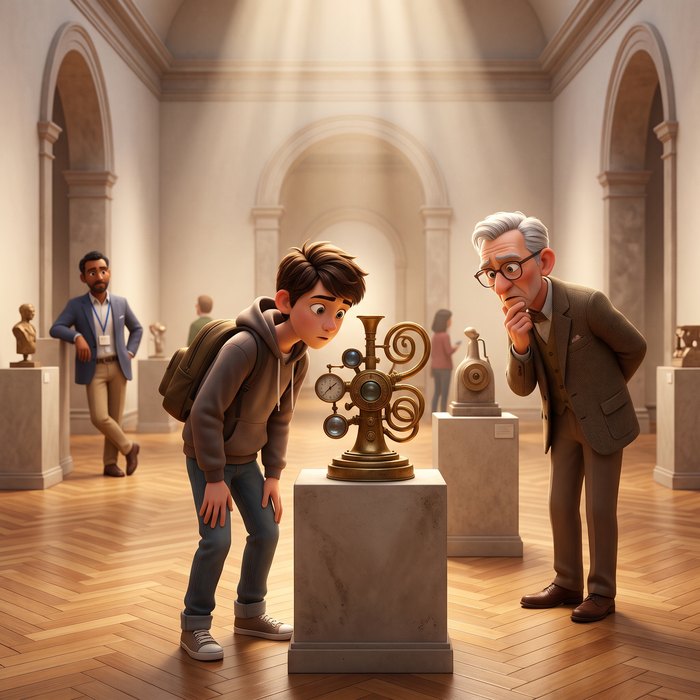
The Bellweather Museum's new director had a theory: visitors were spending too much time reading and not enough time looking. So, for one weekend, she removed every label from the museum's main gallery.
The announcement described the experiment as an invitation to curiosity. Without dates, titles, or explanations, visitors would have to observe the objects and form their own questions. The director expected lively conversations, thoughtful guesses, and perhaps a few discoveries that the curators had overlooked.
At first, the gallery seemed transformed. A group of school students gathered around a brass instrument with a curved handle. One suggested it was used to measure rainfall; another was certain it belonged to a travelling magician. An older visitor stared at a cracked ceramic bowl and decided it must have been used in a famous royal ceremony.
The guesses were imaginative, but they were not necessarily useful. The brass instrument was actually a nineteenth-century tool for testing fabric tension. The bowl had belonged to an ordinary household and had been repaired several times. Neither object had a particularly dramatic history, though both revealed something about everyday life.
By midday, the information desk had a queue. Some visitors wanted to know whether an object was safe to touch. Others had found a symbol they thought might be religious and wanted confirmation. One man complained that he had travelled a long distance to see a particular exhibit but could not identify it without its label.
The director was reluctant to abandon the experiment. She argued that uncertainty made visitors more active participants. The chief curator countered that curiosity needed a starting point. A person could wonder about an unfamiliar object more easily if they knew at least what kind of thing it was, when it was made, or where it had been found.
They compromised the following morning. The museum restored short labels with each object's name, date, and place of origin. Longer explanations remained available in a small guide near the entrance. Visitors were encouraged to look first, guess if they wished, and then check their ideas.
The response improved almost immediately. People still debated the brass instrument, but now their theories began with a shared fact rather than a complete absence of information. Several visitors even returned to objects they had hurried past the previous day.
The director kept one lesson from the experiment: labels can dominate attention if they are too long or too prominent. But she also accepted that removing every clue had not made the collection more accessible. The museum had mistaken a lack of information for an invitation to think.
Fiction note: All people, places and events in this text are fictional.