In life, you often get emails or letters like a party invitation, a message from an old friend, a complaint from a customer, or a request for an interview. This page teaches you how to reply to emails like these, step by step.
This page does not try to cover every email situation under the sun, and it is not a one-size-fits-all template. Instead, it teaches a method for the most common everyday situations, which you can then adapt to your own. This is also not an exam-preparation page — English But Better is not a Cambridge exam resource, and this is not an exam-tailored website — but many of the skills you learn here are useful if you are preparing for an official English exam at this level.
A note about word counts
Most official English exams ask for a specific number of words, such as 100 words, 300–400 words, etc. We are not tailoring this lesson to accommodate that.
Instead, here is what those numbers mean: those numbers are only meant to show how much text they want you to write on your paper. Think of it this way: 100 words is about half a sheet of paper. 300–400 words means they want you to fill the whole sheet of paper. About 1,000 words means they want you to fill a whole sheet and half of the back.
In a timed exam, you will not have time to count words. Counting only wastes time. Instead, read those numbers as how much of the sheet they want you to fill.
That is why this website’s writing lessons do not enforce a strict word count.
That said, if you are taking an official exam, meeting the exact word count can be an essential part of that exam’s requirements, so it is worth checking the number once you have finished writing.
Just be careful: stopping to count words while you write will cost you time you may not have, especially if writing does not come easily to you yet. Use the page-fullness guide above while you write, and only check the exact count at the end, if your exam requires it.
A successful reply to an email has these four parts, and here is what each one is for:
AOpening
Greet the sender and show you read their email.
Opening
-
1
Write a greeting with the sender's name: "Hi Emma!", "Hello Vincent,", "Dear Mr Davis,"
"Hi Emma!" is casual — use it with friends or family. "Hello Vincent," is semi-formal — use it with people you know but aren't close to. "Dear Mr Davis," is formal — use it with strangers, at work, or for a complaint. Pick the one that matches your relationship with the sender, and keep that same level of formality in your sign-off at the end (Part D). -
2
Write one line reacting to their news: "Thanks for inviting me!", "That's great news!", "I was happy to hear from you."
Other examples, depending on the situation
- Thanks for inviting me!
- Your party sounds great!
- I'd love to come!
- It's great to hear from you!
- It's been a long time!
- I'd love to see you again!
- It's great that you're visiting!
- I'd be happy to help!
- Here are some ideas for you.
- Thank you for your reply.
- I'm writing about my visit.
- I'd like to explain the problem.
- Thank you for contacting me.
- I'm pleased to hear from you.
- Thank you for the invitation.
More examples for these situations →
What not to do here
Don't start answering the four points here.
Yes. Pizza. Cake.
Hi Emma! Thanks for inviting me! I'd love to come!
BSender's questions/points 1 and 2
Answer the first two points, in their original order.
Sender's questions/points 1 and 2
-
1
Start with a word or phrase that connects to your opening: "Regarding your invitation,", "About your news,", "To answer your questions,"
-
2
Underline the sender's question/point 1. If it isn't already a question, turn it into one. Write it on paper: "Can I come?", "Can you help?", "Is it free?"
-
3
Write its answer. Repeat the same two steps (question, then answer) with the sender's question/point 2: "Yes, I'd love to come!", "Sorry, I can't make it.", "That sounds great, thanks."
-
4
Join both answers using and, but, because or so: "I'd love to come, and I'd like some pizza, please.", "I can't come, but I can help you prepare for it.", "I can come, because I already asked for the day off."
Other examples, depending on the situation
- Yes, I'd love to come!
- Sorry, I can't come.
- I'd like some pizza, please.
- Saturday is perfect for me.
- I'm free next weekend.
- We could meet at a café.
- You could stay near the centre.
- You should visit the old town.
- There's a nice hotel nearby.
- I visited last Friday.
- My food was cold.
- I received the wrong meal.
- Monday is fine for me.
- Tuesday would be better.
- I have some experience.
More examples for these situations →
What not to do here
Don't answer only yes or no.
Yes! A party! Yeey! More excuses to skip homework.
Yes, I'm free next Saturday, so I'll be there. I'd like some pizza, please.
CSender's questions/points 3 and 4
Answer the last two points, in their original order.
Sender's questions/points 3 and 4
-
1
Start with a word or phrase that moves on from your last answer: "Moving on,", "As for the rest,", "Also,"
-
2
Underline the sender's question/point 3. If it isn't already a question, turn it into one. Write it on paper: "Can I help?", "Where should we meet?", "What should I bring?"
-
3
Write its answer. Repeat the same two steps (question, then answer) with the sender's question/point 4: "Yes, I can bring a cake.", "I'll take the bus.", "I'm free in the afternoon."
-
4
Join both answers using also, or or so: "I can help with the food, and I can also bring some music.", "I can bring a cake, or I could bring drinks instead.", "I'm free that day, so just let me know the time."
Other examples, depending on the situation
- I can bring some drinks.
- I can help with the decorations.
- I'll take the bus.
- We could invite some old friends.
- I can bring some photos.
- We could have lunch together.
- You should try the local food.
- You can travel by bus.
- Spring is a good time to visit.
- I spoke to the waiter.
- I would like a refund.
- I hope you can solve this problem.
- I can bring my CV.
- I can attend in person.
- An online meeting is better for me.
More examples for these situations →
What not to do here
Don't leave the sender's question/point 3 or 4 unanswered.
Anything would be better than cleaning my garage.
I can help you decorate the house. I'll take the bus, so I'll arrive early.
DClosing
Give the email a clear ending and show what happens next.
Closing
-
1
Start with a word or phrase that signals you are finishing: "Finally,", "Before I go,", "To finish,", "Anyway,", "Before I forget,"
"Finally," and "To finish," are not wrong — they are clear and well organised, which is useful in a formal email or an exam. "Anyway," and "Before I forget," sound more natural in a casual email to a friend. Neither one is "more correct": it depends on how formal you want to be. -
2
Write one line about the next step: "Let me know what time to arrive.", "I look forward to hearing from you.", "Please confirm by Friday."
-
3
Write a sign-off for this relationship: "See you soon,", "Best wishes,", "Kind regards,"
-
4
Write your name underneath: "Tom", "María", "J. Davis"
Other examples, depending on the situation
- Let me know the time.
- Hope to see you there!
- See you soon!
- Let me know which day is best.
- I hope we can meet soon.
- Take care!
- I hope this helps!
- Enjoy your visit!
- Best wishes,
- I look forward to your reply.
- I hope we can find a solution.
- Yours sincerely,
- I look forward to hearing from you.
- Please let me know the date.
- Kind regards,
More examples for these situations →
What not to do here
Don't use a friend's sign-off in a formal email.
See you soon! Tom
Yours sincerely, Tom
Answering only "Yes" or "No".
Add useful information to your answer.
Skipping one of the four points.
Give every point its own answer.
Adding information the sender didn't ask for.
Keep extra details relevant to the sender's message.
Example models
See the full example below: the first letter is the sender's message, and the second letter is a model reply.
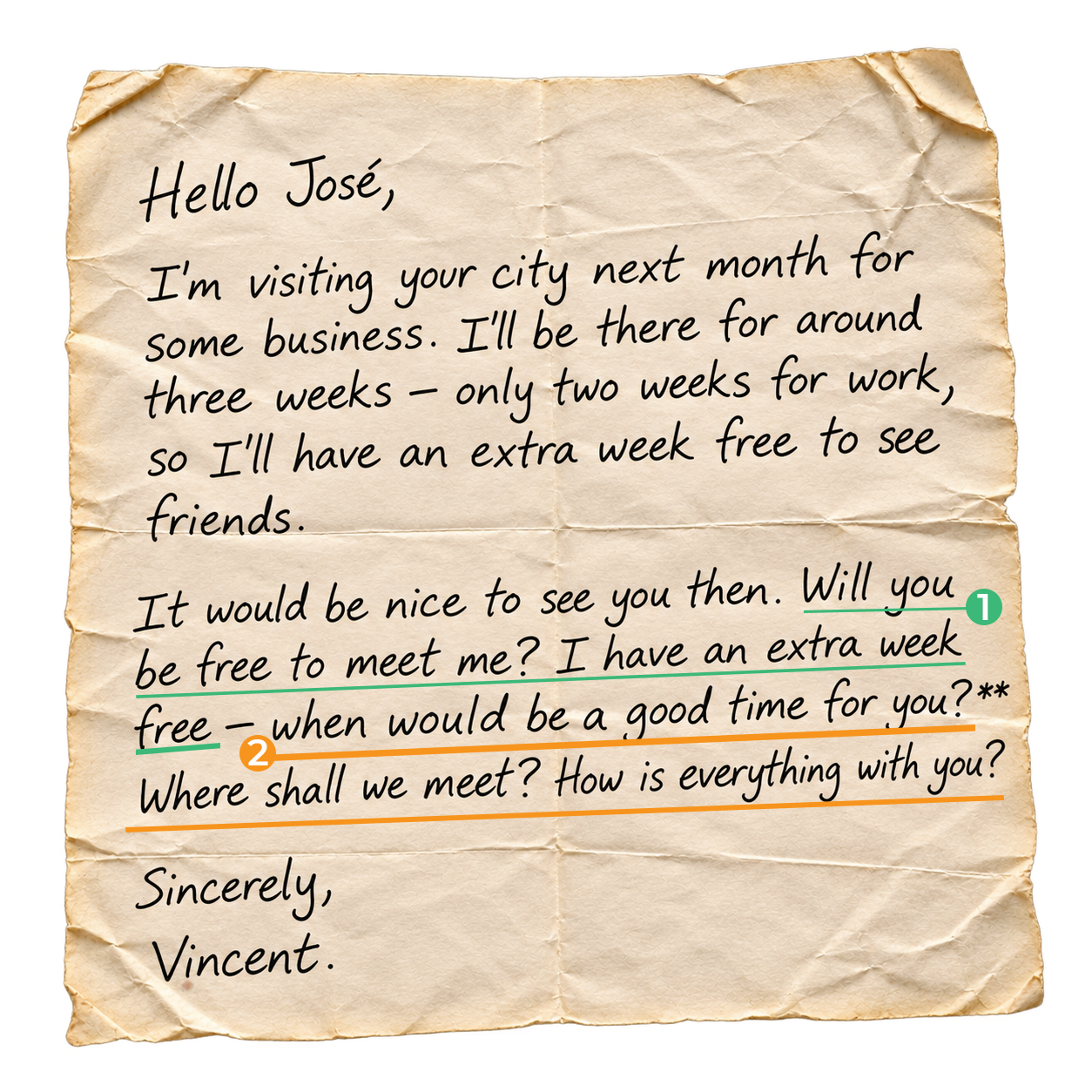 Full text of Vincent's email: Hello José, I'm visiting your city next month for some business. I'll be there for around three weeks — only two weeks for work, so I'll have an extra week free to see friends. It would be nice to see you then. Will you be free to meet me? I have an extra week free — when would be a good time for you? Where shall we meet? How is everything with you? Sincerely, Vincent.


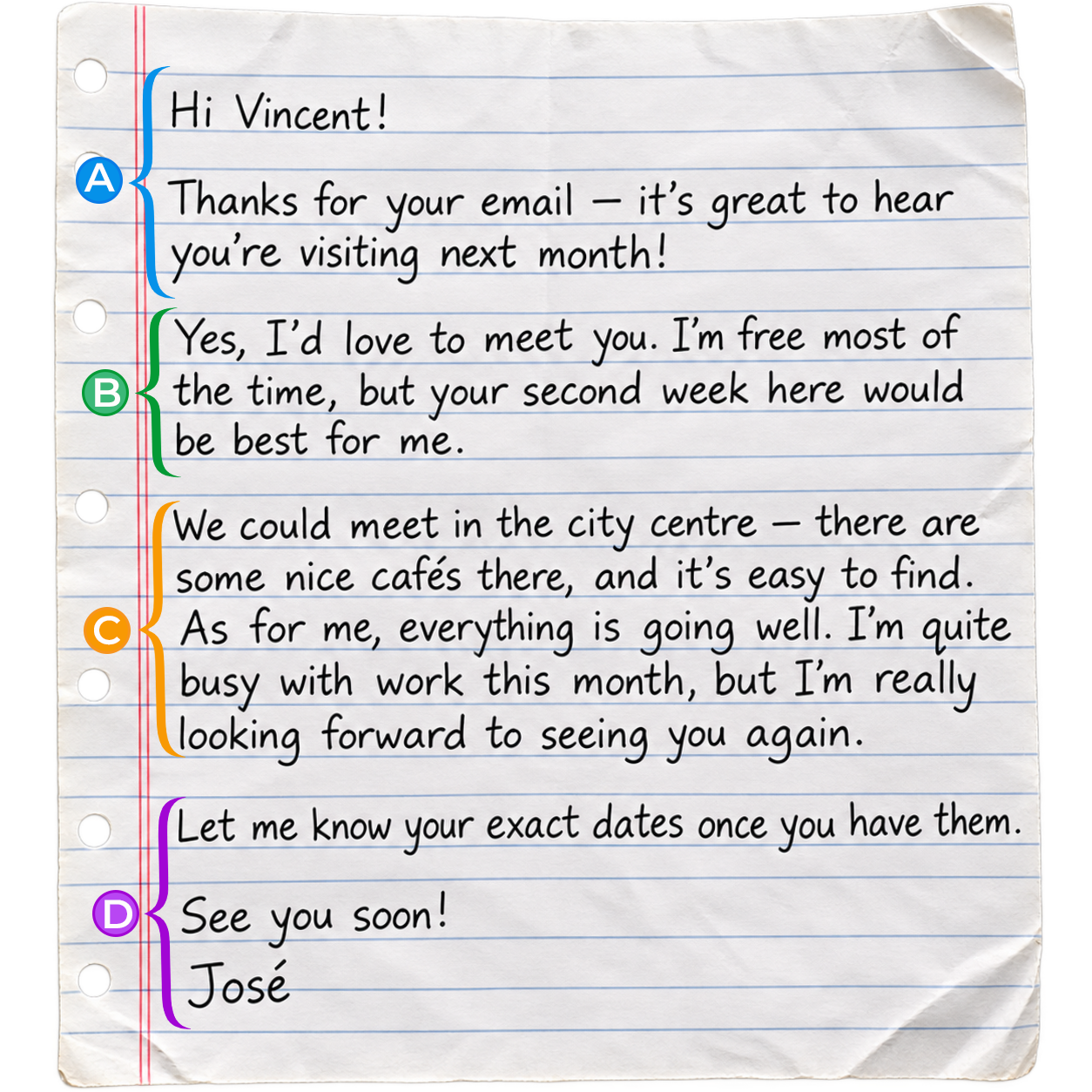 Full text of José's reply: Hi Vincent! Thanks for your email — it's great to hear you're visiting next month! Yes, I'd love to meet you. I'm free most of the time, but your second week here would be best for me. We could meet in the city centre — there are some nice cafés there, and it's easy to find. As for me, everything is going well. I'm quite busy with work this month, but I'm really looking forward to seeing you again. Let me know your exact dates once you have them. See you soon! José.
Before you finish
Your turn: reply to the email
Choose one of the two emails below to reply to. Underline its four requests on paper — small talk is not a request — then write your reply using Parts A to D. Remember to do the final check.
Hey mate! How's it going? Still busy with school?
Need your help! My mum's birthday is next Saturday, and I need your help. I don't want to get her the usual cake, perfume or bathroom air freshener, because she already has a lot of those! Do you have any ideas for a present? It doesn't have to cost much.
What did you get your mum last year? Could you help me make the present, or do you think it's a bad idea? I'm so bad at these things, you know. Maybe we could meet this week to plan it.
Thanks, mate!
Alan.
Hello there, you ghost! Haha, long time no see. How are you doing?
Hey, I'm thinking about moving to a new city. I need a change after a break-up, and I want somewhere quieter. What is your city like, and is it a good place for someone who lives alone with a cat? I like walking my cat in a park, and on Friday nights I like ordering food and not waiting too long for it. Is there a place like that in your city, or which area would you recommend? Are you free to hang out at the weekend? Also, do you know a good place to play guitar? I play a bit.
I hope to hear from you soon!
Jayden.
Write down below your reply letter and we will give you a high quality instant feedback on your writing.