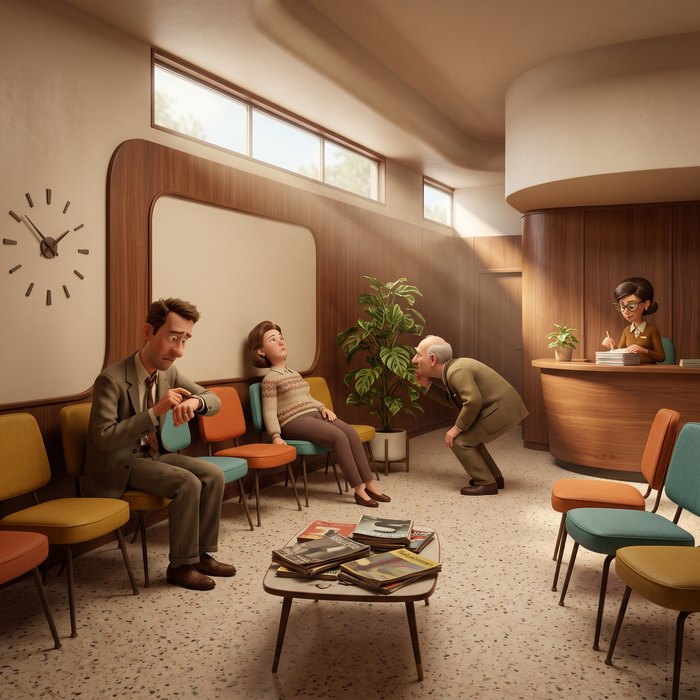
A waiting room is a peculiar institution. It is designed to make waiting possible while reminding us, through every chair and clock, that we would rather be somewhere else. Its furniture promises comfort; its atmosphere quietly withdraws the offer.
We arrive with the assumption that our time belongs to us. Then someone behind a desk asks us to wait, and the ownership becomes negotiable. The minutes continue to pass, but they no longer seem entirely ours. We cannot use them freely because we are expected to remain available for an event whose timing we do not control.
This is why a ten-minute delay can feel longer than an hour spent choosing a holiday destination. Duration is measurable, but waiting is experienced through uncertainty. When we know what comes next, time has a shape. When we do not, each minute becomes a small unanswered question.
The waiting room also exposes our dependence on visible activity. A magazine offers the respectable appearance of occupation. A phone provides a portable escape hatch. Even staring at a clock becomes a task, although it produces no result beyond confirming that time has continued its irritating work.
There is something almost theatrical about the arrangement. The receptionist controls information, the clock performs authority, and the visitor tries to look patient without appearing indifferent. Nobody explicitly demands this performance, yet most of us understand the script. We lower our voices, avoid taking up too much space, and behave as though stillness were a form of good manners.
Of course, waiting is not always oppressive. A quiet room can offer relief from the demands of constant response. Without emails to answer or decisions to make, a person may notice thoughts that ordinary busyness keeps at a distance. The same pause can feel restorative when chosen and humiliating when imposed.
That distinction matters. We do not resent every interruption or every delay. We resent being denied meaningful choice while being expected to pretend that the arrangement is perfectly reasonable. A delayed appointment may be unavoidable; treating visitors as though their time has no value is not.
Perhaps the waiting room's deepest lesson is not that modern life moves too quickly. It is that we have become uncomfortable when we cannot direct its pace. We tolerate hours of entertainment but struggle with ten unclaimed minutes, especially when someone else controls the door through which our next activity must pass.
A better waiting room would not need to entertain us constantly. It would offer clear information, comfortable surroundings, and some respect for a person's day. The aim would not be to abolish uncertainty, but to remove the unnecessary indignities we have built around it.
Fiction note: All people, places and events in this text are fictional.