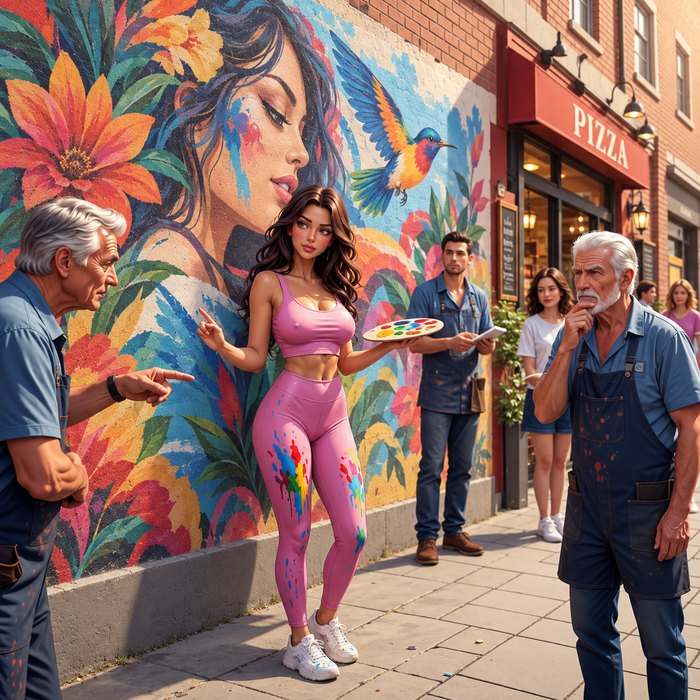
Interviewer: Your murals appear on ordinary walls around the city. Why work in public spaces rather than galleries?
Mara: Because people don't have to decide to visit a gallery. They might be walking to work, taking their children to school, or waiting for a bus. Suddenly, there's something on the wall that makes them stop for a moment.
Interviewer: Do you always plan a mural before you begin?
Mara: I plan the main idea, but I leave room for changes. A wall isn't a clean sheet of paper. It has cracks, pipes, old paint, and sometimes a window right where I wanted a character's face. I try to work with the place instead of pretending it isn't there.
Interviewer: How do people react to your work?
Mara: It depends. One shop owner worried that a mural would make the street look less professional. After we talked, I included an image connected to the area's history. Now he points it out to customers. Another resident complained that the colours were too bright. I can't please everyone, and I don't think I should try to.
Interviewer: So the artwork can change people's relationship with a place?
Mara: Exactly. People start noticing a wall they've walked past for years. Sometimes they tell me their own stories about the street. Those conversations can be just as valuable as the finished painting.
Interviewer: What's the hardest part of the job?
Mara: Not the painting. It's getting permission, organising materials, and working around traffic and weather. People imagine artists simply arrive with a brush and inspiration. In reality, there's a lot of paperwork behind a picture of a giant blue bird.
Interviewer: What would you say to someone who thinks street art is just decoration?
Mara: I'd ask them to look again. Decoration can be lovely, but a mural can also ask a question, remember a person, or help people see their neighbourhood differently. If someone notices something they hadn't noticed before, the wall has already done some work.
Fiction note: All people, places and events in this text are fictional.