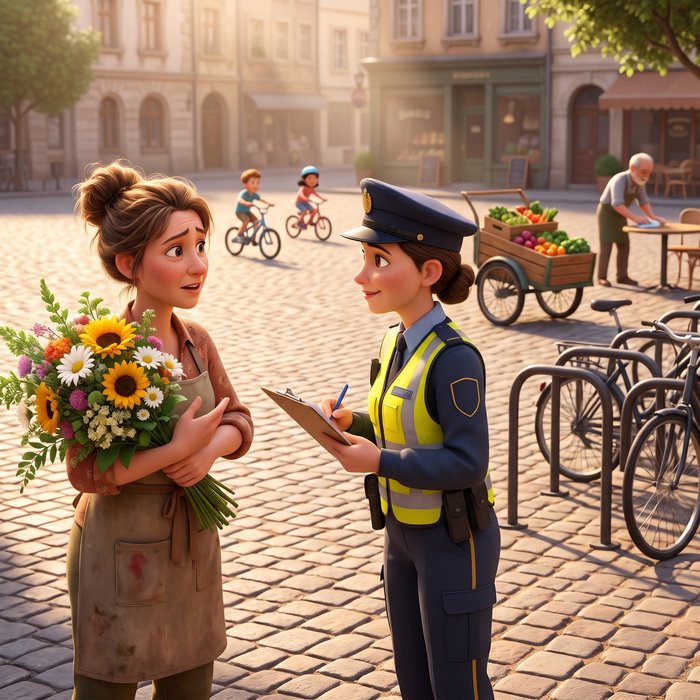
At seven on Saturday morning, the village of Bellmere closed its main streets to private cars. The council had advertised the event as a trial of a quieter, safer centre. Residents were encouraged to walk, cycle, or use a shuttle bus running between the station and the market square.
By nine, the square looked less like a road junction and more like a public living room. Children chalked pictures on the pavement, a baker placed two tables outside his shop, and an elderly couple crossed the street without waiting for a gap in traffic. The bakery sold out earlier than usual, though the owner admitted that the weather might have helped.
Not everyone was pleased. A florist complained that customers carrying large arrangements could not park outside her door. A delivery driver arrived with boxes of vegetables and found that his usual unloading point had been replaced by a row of bicycle racks. He had not received the updated access instructions.
The council's transport officer, Lena Morris, acknowledged the confusion. Emergency vehicles and approved deliveries were still allowed through designated routes, but the information had not reached every business. She arranged a temporary unloading area and promised a clearer notice system if the village repeated the trial.
Meanwhile, the shuttle bus became unexpectedly popular. Some passengers used it to carry shopping, while others rode the full route simply to see the village from a different perspective. The driver reported that people who usually drove short distances were asking where the next stop was.
At the end of the day, the council collected feedback. Several residents praised the quieter streets, but others pointed out that people with limited mobility needed reliable transport and convenient drop-off points. The florist suggested timed access for customers collecting large orders. The baker proposed keeping the square car-free on summer weekends.
Lena resisted declaring the experiment an immediate success. One sunny Saturday could not prove that a permanent ban would work, she said, especially when some businesses had struggled with deliveries. But the trial had revealed something useful: the argument was not simply about cars versus pedestrians. It was about designing streets that served different needs without allowing vehicles to dominate every space.
The council promised to publish the feedback before making a decision. By Monday, the village had returned to normal traffic. Yet the bicycle racks remained in the square, and the baker had left one table outside. People kept stopping there to talk, even when cars passed again.
Fiction note: All people, places and events in this text are fictional.