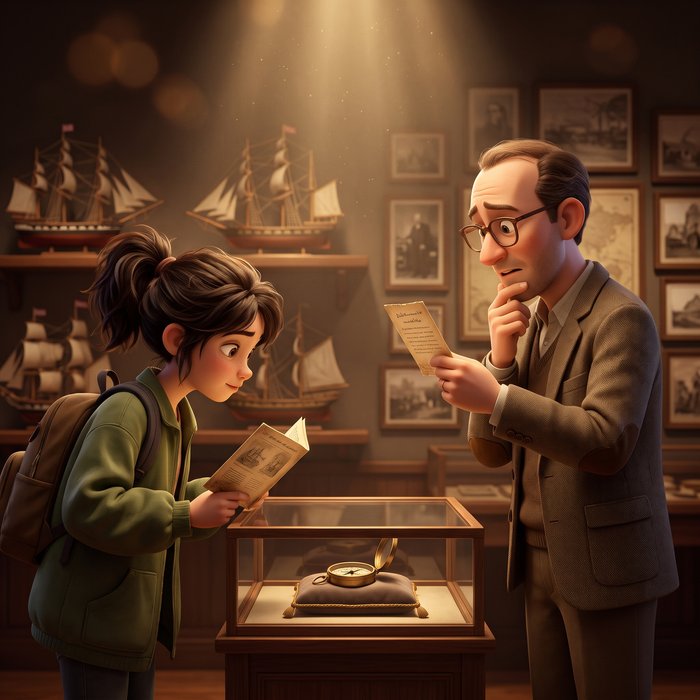
When the Bellweather Maritime Museum discovered that a compass had been displayed under the wrong label, the mistake seemed easy to correct. The curator replaced the card, updated the website, and added a note to the internal catalogue. The object had belonged to a coastal survey vessel, not to the famous explorer named on the old label.
That should have been the end of it. Instead, twenty years later, the museum received an email from a secondary-school student called Leah.
Leah was preparing a project about the explorer. She had found the compass in an old museum booklet, a photograph in a local newspaper archive, and a page on a history website. All three sources gave the same incorrect attribution. She wanted to know why the museum's current website identified the object differently.
The curator, Simon, checked the records. The newspaper had photographed the original display. The booklet had copied the newspaper caption, and the history website had taken its information from the booklet. Each source appeared to confirm the others, although all three led back to the same mistake.
Simon was embarrassed. The museum had corrected its own display, but it had never contacted the newspaper or the booklet's publisher. Later, staff had assumed the online information was independent confirmation rather than another copy of the original label.
His colleague suggested that the museum simply send Leah a short correction. The current label was accurate, after all, and the old booklet was out of print. Simon disagreed. If the museum wanted visitors to trust its information, it had to acknowledge its part in the confusion.
He wrote back to Leah, explained the chain of copying, and sent her the relevant catalogue entry. Then he contacted the newspaper archive and the history website. Both agreed to add correction notes. The booklet could not be changed, but the museum scanned the relevant page and placed it beside the corrected display, showing visitors how the error had travelled.
Leah revised her project. Rather than presenting three sources as separate proof, she explained that they all repeated one original claim. Her teacher liked the distinction and asked her to share the example with the class.
The museum also changed its procedures. When correcting a published error, staff would now check whether other sources had repeated it. They began recording where old information had appeared, not merely what the new label should say.
Simon did not enjoy admitting the mistake. Yet the response brought something useful to light: a correction inside one institution cannot automatically repair every copy outside it. Sometimes the most responsible way to protect trust is to show exactly how trust was misplaced.
Fiction note: All people, places and events in this text are fictional.