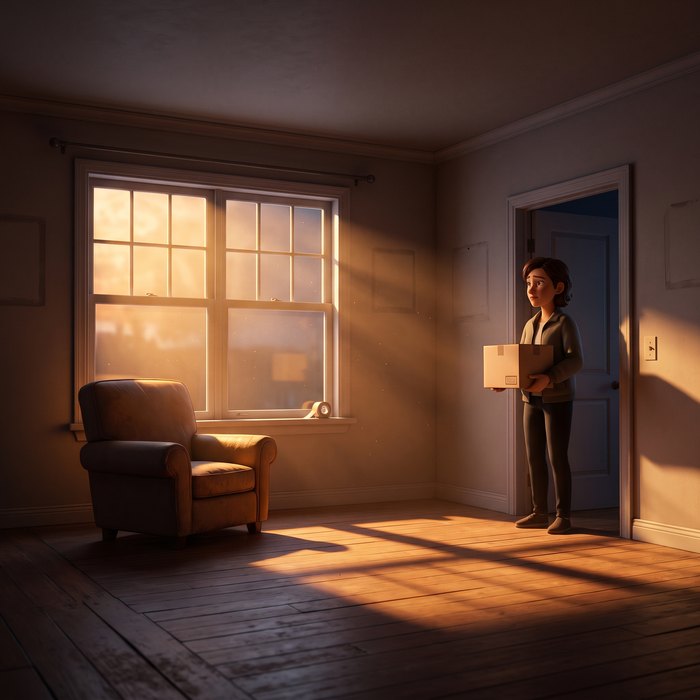
An empty room is not necessarily a light room. Remove the furniture, the books, the inconvenient lamp that nobody admits to buying, and the space may become physically easier to cross. Emotionally, however, it can acquire an alarming density.
The obvious explanation is memory. Rooms are not neutral containers; they are informal archives. A dent in the floor recalls a heavy table, a pale rectangle on the wall suggests a picture, and a familiar corner can preserve the outline of someone who no longer visits. Absence becomes legible through what remains.
Yet memory alone does not explain the sensation. An unfamiliar room can feel oppressive before it has accumulated a single personal association. Its emptiness creates a demand: imagine its purpose, decide where to sit, determine whether you belong. Furniture usually answers such questions silently. Without it, the room returns the problem to you.
There is a peculiar asymmetry here. A crowded room offers too much information, but an empty one offers too few instructions. In the first, attention is occupied. In the second, attention begins inspecting itself. You notice the clock, your posture, the delay before a sound arrives. Nothing has happened, yet the mind starts manufacturing events from possibility.
This may explain why empty rooms are so often described as waiting. Strictly speaking, they wait for nothing. Waiting is an activity performed by a person who has assigned meaning to an interval. The room simply remains available, indifferent to the story being projected onto it.
Of course, architecture can intensify the effect. High ceilings may suggest grandeur or exposure; narrow windows can turn openness into confinement. But these features do not determine the emotional result. One person sees a blank canvas, another sees evidence that life has stopped. The room supplies conditions, not a verdict.
Perhaps its weight comes from the absence of distractions. In a furnished space, objects divide our attention and offer excuses for remaining busy. An empty room removes these convenient intermediaries. We encounter our expectations without much furniture between us and the encounter.
That is not always unpleasant. Emptiness can also offer relief, a pause in which nothing is asking to be repaired, purchased, displayed, or explained. The same bare walls can feel like abandonment on Monday and freedom on Friday. The room has not changed. The visitor has.
We tend to measure spaces by what they contain, as though meaning were a substance that could be stored on shelves. But perhaps a room's true weight is the pressure of what we bring into it: memory, expectation, unease, possibility. Empty, it is not without content. It has simply stopped supplying the contents for us.
Fiction note: All people, places and events in this text are fictional.