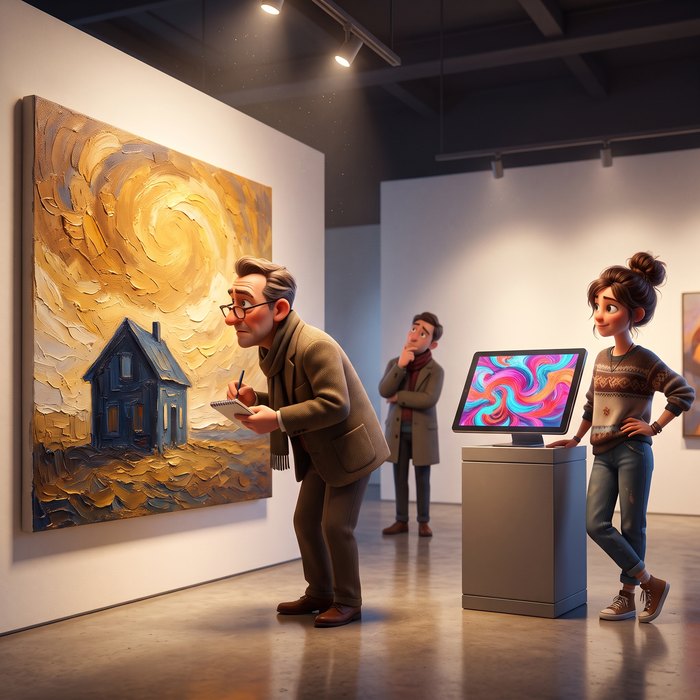
Mara: You called the painting emotionally vacant, yet three visitors stood in front of it for nearly ten minutes. What exactly were they responding to?
Julian: The image is technically accomplished. The light is convincing, the composition is balanced, and the blue house has an almost theatrical loneliness. But I see no evidence that the work required anyone to feel that loneliness.
Mara: You are assuming that an artwork must contain the artist's private emotion before it can produce an emotion in someone else.
Julian: Not necessarily. A landscape can move me without its painter having suffered a tragic childhood. Still, there is a difference between expressing an experience and assembling the visual signs associated with one.
Mara: The painting was generated by an AI system using a prompt I developed, dozens of rejected variations, and substantial editing. I selected the final image because it captured something I could not quite explain in words.
Julian: That sounds like curation. The system produced the image, and you recognised one you liked. Why should that make you its painter rather than its editor?
Mara: Why should a painter's use of a brush automatically make them the author? Artists have always relied on tools, conventions, assistants, and accidents. Authorship has never been as solitary as the romantic story suggests.
Julian: Tools do not usually decide what to depict. This system draws on patterns learned from vast collections of existing images, many made by people who never agreed to have their work used that way. You cannot separate the aesthetic result from the ethics of its production.
Mara: I agree that consent and compensation matter. But those questions do not prove that the image itself is incapable of artistic meaning. We can criticise the process without pretending the result has no value.
Julian: Perhaps. Yet the gallery's label describes you as the artist and says nothing about the system's role. That omission encourages viewers to imagine a human hand behind every brushstroke.
Mara: Then the label should be more honest. It could explain the process and let visitors judge the work with that knowledge. I have no interest in passing software off as a lonely genius in a studio.
Julian: Would you accept the same judgment if visitors decided the painting was less impressive once they knew how it was made?
Mara: Of course. Context can change how we see something. But if the painting becomes worthless the moment its origin is revealed, perhaps the critic has been reviewing the story rather than the image.
Julian: Or perhaps the story is part of the image's meaning. I admit I cannot settle that by looking at the canvas alone.
Mara: And I cannot settle the ethics by pointing at the canvas and calling it beautiful.
Fiction note: All people, places and events in this dialogue are fictional.