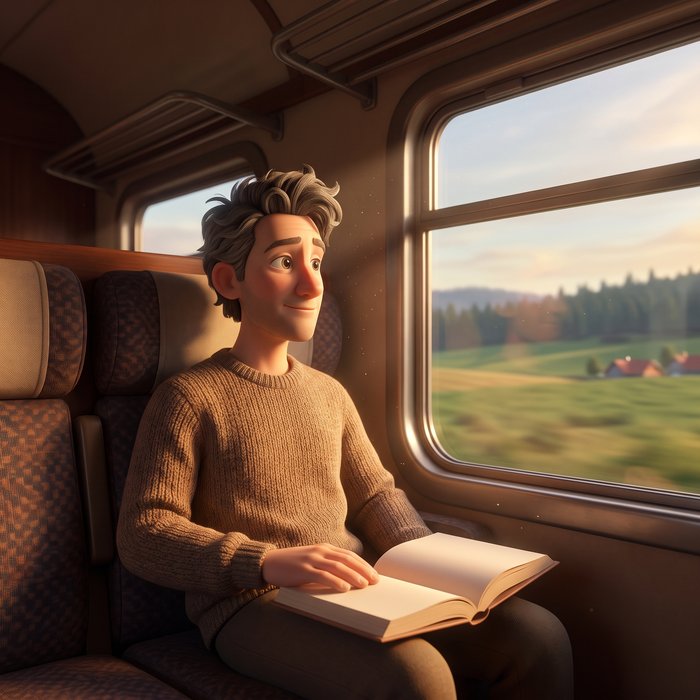
Why do people willingly spend six hours on a train when a plane could take them to the same city in less than one? The answer is not always about price or convenience. Sometimes, the journey itself is the point.
On a train, the landscape changes gradually. Fields become forests, forests give way to small towns, and familiar buildings disappear behind distant hills. Unlike flying, where much of the view is hidden by clouds or darkness, a train offers a moving picture of the places between destinations. Even passengers who rarely look out of the window may find themselves checking it again and again.
Long journeys also create a rare kind of free time. At home, people often feel they should be doing something useful. At work, a quiet moment can quickly fill with messages and requests. On a train, however, there is a natural excuse to do very little. Reading a novel, listening to music, writing in a notebook, or simply staring outside can feel like a perfectly reasonable use of the afternoon.
There is also the strange social atmosphere. Passengers share a space without needing to share their lives. A stranger might offer to lift a suitcase, point out a beautiful view, or explain why the train has stopped in the middle of nowhere. These brief encounters can be pleasant precisely because they do not usually lead to obligations. People can be friendly without becoming friends.
Of course, not every long journey is charming. Delays, crowded carriages, uncomfortable seats, and noisy phone calls can quickly spoil the mood. The appeal depends partly on having enough space and time to relax rather than constantly checking the clock.
Perhaps the real attraction is that train travel changes our relationship with time. Instead of treating every minute as something to save, passengers can watch it pass. The destination still matters, but for a few hours, arriving is not the only reason to travel.
Fiction note: All people, places and events in this text are fictional.