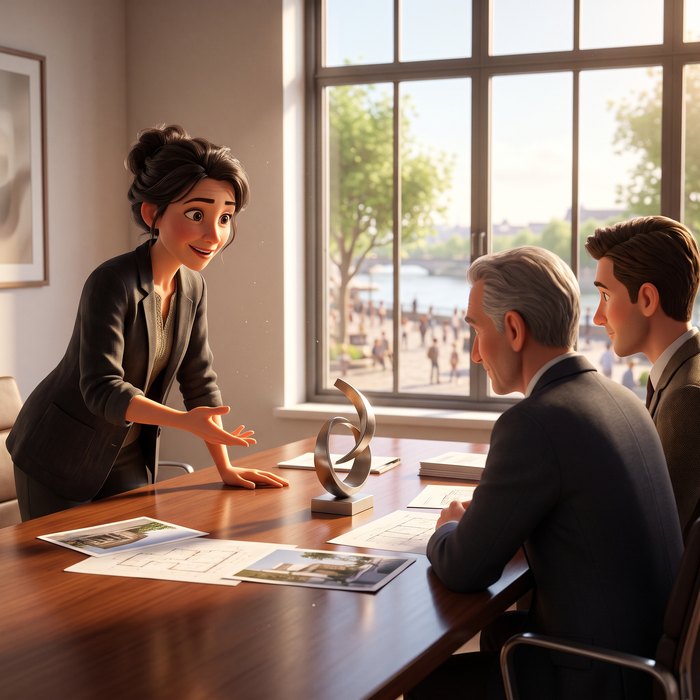
The city council had commissioned a monument to mark the opening of its new riverside district. The brief sounded straightforward: create something permanent, dignified, and recognisably local. Then sculptor Amara Voss submitted her proposal, a towering steel structure whose curved sections appeared to lean away from one another without quite separating.
At the first review, the council's cultural director, Mr Bell, studied the model in silence.
“It's impressive,” he said at last. “But people will ask what it represents.”
“That's useful,” Amara replied. “It means they'll look at it long enough to ask.”
Bell did not smile. He had expected a figure from the city's history, perhaps a founder on horseback or a symbolic worker holding a tool. Amara's design contained no figures, flags, or familiar emblems. Its empty centre framed the river beyond it, changing the view as visitors moved around the sculpture.
The council's practical concerns were not entirely unreasonable. The structure would need a larger foundation than the original budget allowed, and its exposed steel required a maintenance plan. Amara accepted the need for an engineering review but resisted the suggestion that she add a bronze plaque explaining the sculpture's meaning.
“A plaque would settle the question before anyone has a chance to have it,” she said.
At the second meeting, Bell proposed a compromise: retain the design but place it on a raised platform, where it would look more monumental. Amara objected that the platform would block the river view for children and wheelchair users approaching from the lower path. She brought photographs taken at eye level from several points around the site, showing how the existing slope already made the structure appear taller from the main entrance.
Bell examined them, then asked whether the council could approve the sculpture without pretending to understand it completely.
“That,” Amara said, “would be an excellent start.”
They reached an agreement. The council funded the stronger foundation and a scheduled inspection plan. Amara kept the open centre, rejected the platform, and agreed to install a small information panel listing the materials and the engineers involved, without prescribing an interpretation.
On opening day, a local journalist asked Bell whether the city had finally decided what the sculpture meant.
Bell glanced through its steel curves at the moving river.
“We decided it belonged here,” he said. “That may be enough.”
Fiction note: All people, places and events in this text are fictional.