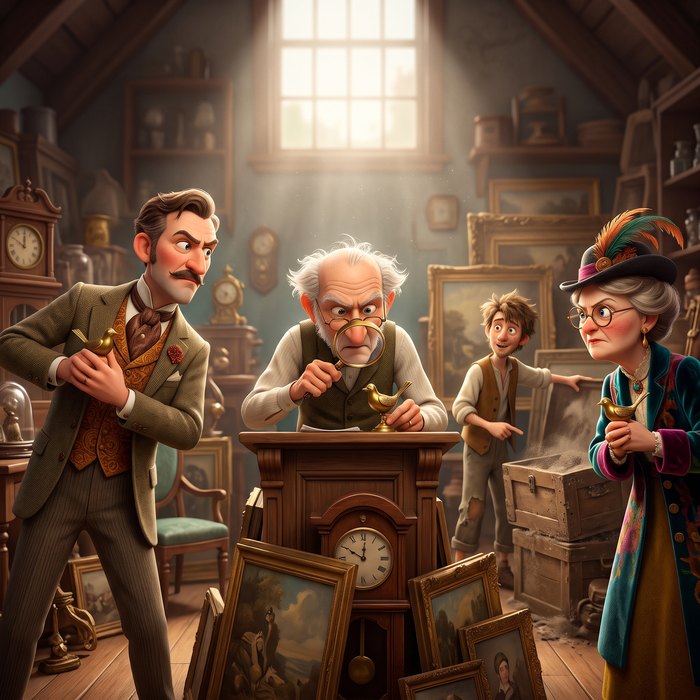
For twenty years, Elias Venn had built his reputation on finding overlooked objects and recognising what others dismissed as junk. His rival, Marcus Vale, had a less patient approach. Marcus watched auctions closely, bought aggressively, and seemed to appear wherever Elias had recently made a discovery.
When Elias acquired a tarnished brass bird at a country sale, he noticed a tiny engraving beneath one wing: a crescent beside three dots. He recognised it as the mark of a workshop that had supplied decorative objects to a private railway company a century earlier. The bird was not particularly valuable on its own, but its provenance could make it interesting to a specialist collector.
Three days later, Marcus announced that he had found an almost identical bird. Elias immediately suspected that someone at the auction had told Marcus about the engraving. He began to wonder whether the rival had been following him, or whether the auction staff were quietly passing information to the highest bidder.
Their next encounter took place at a regional antiques fair. Marcus displayed his bird beside a handwritten note claiming it had come from a railway official's estate. Elias challenged the claim. The engraving was in the same position, but Marcus's bird had a different base, and its metal showed signs of a more recent casting.
Marcus listened without interrupting. Then he produced a letter he had found inside the lining of an old case purchased with the bird. The letter described a small workshop that had made replicas of railway ornaments for employees who could not afford the originals. Its owner had used the same mark on both authentic pieces and later copies.
Elias examined the letter carefully. The evidence did not prove that Marcus's bird was genuine, but it also weakened Elias's assumption that his rival had stolen a unique discovery. The workshop had deliberately produced near-identical objects, and the mark alone could not settle the question.
Marcus admitted that he had bought the bird because it resembled Elias's find. He had hoped to establish its origin, not to pass it off as an original. He also confessed that he enjoyed competing with Elias more than was sensible.
They agreed to ask an independent specialist to examine both objects. The result confirmed that Elias's bird was an early original and Marcus's was a later workshop copy. Yet the copy was historically interesting in its own right, because it revealed how the railway company's ornaments had spread beyond wealthy owners.
Elias had expected the investigation to expose a dishonest rival. Instead, it exposed the limits of his own certainty. The mark had been a clue, not a verdict, and resemblance had been evidence of a connection, not proof of theft.
Fiction note: All people, places and events in this text are fictional.