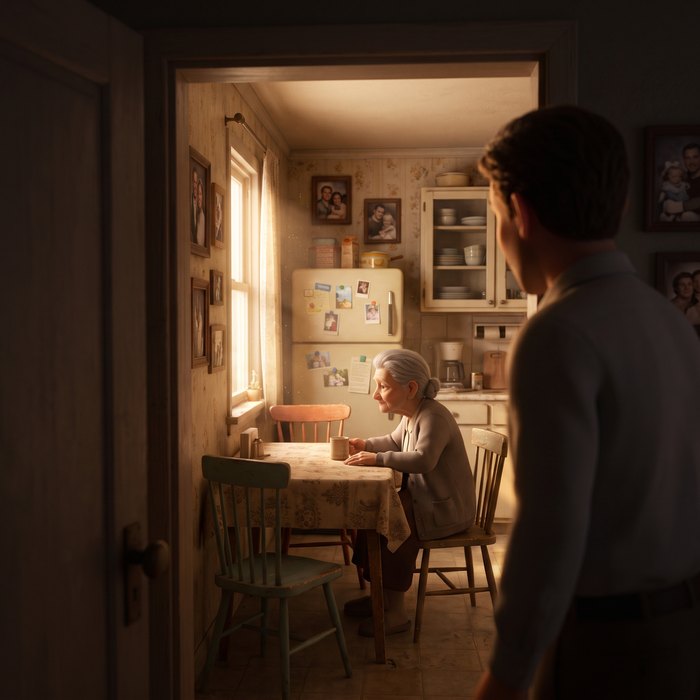
When I was eight, our house seemed to contain entire countries. The cupboard beneath the stairs was a winter kingdom, the space behind the curtains a secret embassy, and the narrow passage to the kitchen a dangerous mountain road that required a running start. My brother and I could spend an afternoon crossing these territories.
I remember the house as enormous, though the estate agent's measurements would probably have embarrassed my memory. The living room was wide enough for football, provided our mother was out and the lamp was moved first. The garden reached all the way to the fence.
The shrinking began gradually. At eleven, I found the cupboard less mysterious. By fourteen, the passage seemed too short for a proper race. When my brother left for university, his bedroom did not become larger to compensate for his absence. It became a room where his old posters curled at the corners and the afternoon sun exposed the dust on his desk.
My parents stayed. They repainted the kitchen, replaced the broken back step, and continued to call the spare room “your brother's room,” even after he had a flat, a job, and a life that no longer required permission to stay out late. The house was changing, but not always in ways a visitor could see.
At twenty-three, I returned for a few months after a relationship ended. I expected the familiar rooms to offer shelter, and they did, though not as I had imagined. My mother left tea beside my door without asking questions. My father quietly repaired a loose handle on my suitcase. Their kindness made the place feel safe; my embarrassment made every room seem smaller.
One evening, I stood in the kitchen and realised that I could reach the sink, the table, and the back door in four ordinary steps. As a child, I had remembered that distance as a journey. I tried to reconstruct the old scale of things, but memory kept supplying the missing space.
Years later, after my parents moved to a smaller flat, I returned to help clear the house. The cupboard beneath the stairs held no secret kingdom, only a vacuum cleaner, two umbrellas, and a box of cables nobody could identify. The garden fence was close enough to touch without crossing the grass.
I felt foolish for expecting the house to explain itself. It had never promised to stay enormous. We had simply lived inside it at different sizes, with different fears, permissions, and ideas about how far the world extended.
I kept one object: a chipped blue tile from the kitchen wall, saved when my father renovated it. It fits in my palm. I cannot tell whether the tile was once larger in my memory or whether my hand has learned to hold more. Either way, it reminds me that a place can shrink without becoming less important.
Fiction note: All people, places and events in this text are fictional.