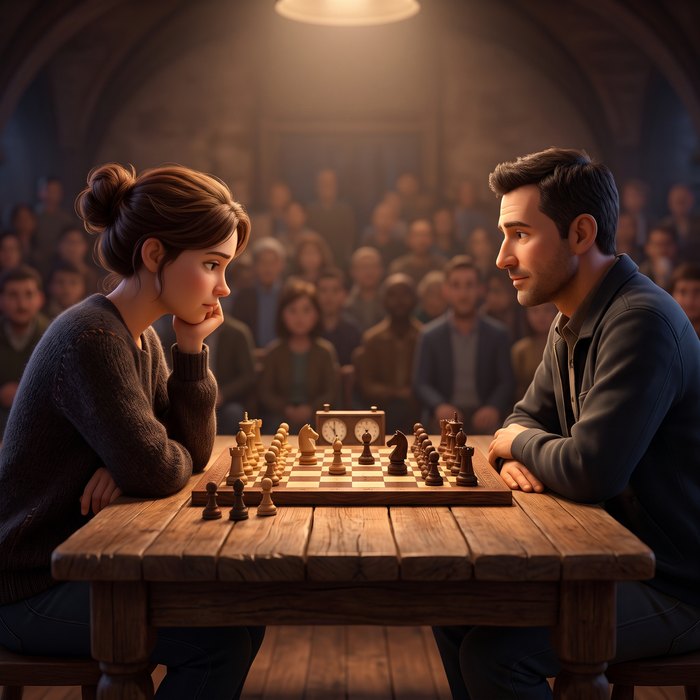
When Elena Ruiz and Tomas Vale agreed to a rematch, the local chess club advertised it as a contest between the city's most stubborn minds. Their first match, three years earlier, had ended in a draw after six hours. Elena had spent the intervening years insisting she had been a move away from victory; Tomas had spent them saying that a move away was still a move away.
They arrived with different reputations. Elena had become known for aggressive openings and dazzling combinations. Tomas, now a respected coach, preferred quiet positions in which an opponent's impatience could do more damage than any piece on the board. Neither spoke much before the match began. The audience had arrived ready to read every raised eyebrow as psychological warfare.
Elena opened with a sharp variation she had analysed for months. Tomas responded with a modest pawn move that appeared to surrender the centre. A few spectators exchanged glances. One whispered that Tomas had forgotten his preparation. Elena paused, then advanced her queen's pawn, gaining space and apparently forcing Tomas onto the defensive.
For the next hour, her position looked superior. Yet Tomas had not blundered. He had invited Elena to build an impressive formation that required constant protection. Each new attacking possibility came with another obligation. By move twenty-eight, her pieces were active, but they were also tied to one another. Tomas's position looked passive only to anyone counting threats instead of options.
Elena recognised the trap just as the clock began to matter. She could simplify into a draw, preserving her reputation for precision, or continue pressing and risk losing. The audience expected her to attack. That expectation had become another piece on the board, though neither player could move it.
She chose the quieter line. Rather than chase a spectacular win, she exchanged queens and released the tension. Tomas studied the resulting endgame for several minutes before offering a draw. Elena accepted.
The room was surprised. Someone near the back muttered that the rematch had produced no winner. Elena packed her pieces slowly, then turned to Tomas.
“I finally understood what you were doing last time,” she said. “You were waiting for me to confuse activity with progress.”
Tomas shook his head. “Not last time. This time. Last time, I was just trying not to lose.”
Elena laughed. His honesty made the earlier game seem less like a secret plan and more like two people learning at different speeds. The rematch had not settled who was better. It had exposed how much each had invented about the other.
The club's report the next morning called the result inconclusive. Elena clipped it from the noticeboard and wrote one word in the margin: “Accurate.” Then she took the report to her next coaching session, where she used it to explain that a position could improve even when the score did not.
Fiction note: All people, places and events in this text are fictional.