The Furlonglet, a unit of measurement once used for distances too awkward for ordinary miles and too short for respectable journeys, has been officially retired at the age of 143. Its death was announced quietly in the latest revision of the National Register of Practical Measures, where a footnote replaced its name with “approximately 0.08 standard units.”
For generations, the furlonglet occupied a peculiar niche. It measured the distance between a village's last lamppost and the beginning of the fields, the stretch of corridor between the school office and the room where forgotten umbrellas accumulated, and the length of a queue that looked short until one joined it. Surveyors appreciated its flexibility. Engineers distrusted it. Children, who used it to estimate how far they could run before a parent called them back, considered it perfectly exact.
Its defenders insisted that it was not vague but humane. A furlonglet, they argued, described distance as experienced rather than merely calculated. Two roads of equal length could feel different depending on the weather, the slope, or whether one was carrying groceries. The furlonglet acknowledged that distinction without requiring a committee to invent separate units for every inconvenience.
Its critics had a stronger technical case. The unit had never been defined consistently across regions. In the north, a furlonglet could be stretched by local tradition; in the south, it contracted whenever a measurement needed to fit a printed table. A bridge designed using one district's furlonglets might not align with a road measured in another's. What had once been charming became expensive.
The final blow came when a transport agency attempted to convert historical furlonglet records into digital route data. The software produced three different answers from the same measurements, each defensible under a different local convention. Rather than preserve the ambiguity, the agency chose a standard unit and published a conversion guide. The furlonglet's remaining official uses were withdrawn the following month.
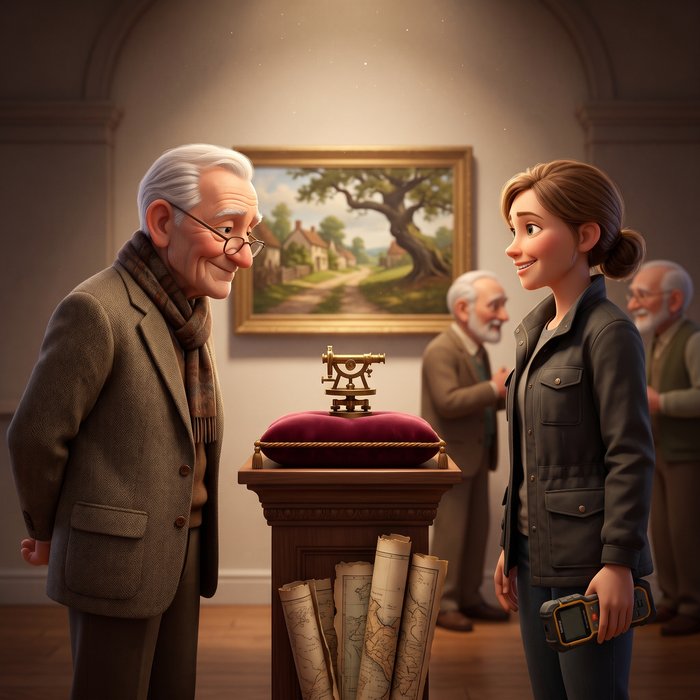
At its memorial, a retired surveyor recalled marking a path as “two furlonglets beyond the bent oak.” He had never needed to explain the measurement to anyone who lived nearby. A young engineer replied that the path was now mapped to the nearest centimetre. Both smiled, though neither suggested that the two descriptions served the same purpose.
The furlonglet leaves no surviving legal function, but its influence remains in everyday expressions that treat distance as a matter of effort, memory, and mood. It was unreliable when a bridge had to meet a road. It was strangely accurate when someone wanted to explain why a walk felt longer on the way home.
Fiction note: All people, places and events in this text are fictional.